
Most catalytic air purifiers need UV light to work. Cold catalyst technology does not — and that changes everything.
Cold catalyst air purification, also known as room-temperature catalytic oxidation (RTCO), is an advanced filtration technology that uses specially formulated catalyst materials to break down harmful pollutants at room temperature — without requiring ultraviolet light, high heat, or energy-intensive ionization. Unlike photocatalytic oxidation (PCO) which relies on UV lamps to activate TiO₂, cold catalyst materials are chemically active at standard indoor temperatures (15°C to 35°C), making them inherently more energy-efficient and safer for continuous home and office use.
For B2B buyers evaluating air purification technologies for their product lines, cold catalyst represents a compelling middle ground between passive activated carbon adsorption and energy-intensive photocatalytic systems. This article explores the science behind cold catalyst technology, its real-world performance advantages, and how manufacturers can integrate it into modern air purifiers.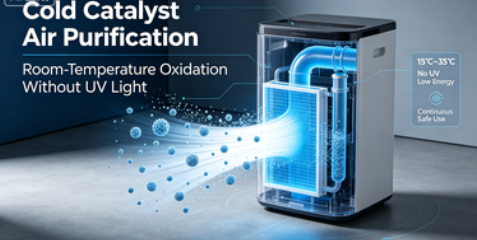
What Is Cold Catalyst Air Purification Technology?
Cold catalyst technology uses a specially engineered catalytic material — typically a composite of transition metal oxides (manganese dioxide MnO₂, cerium oxide CeO₂, or copper oxide CuO) supported on a porous substrate like activated carbon or ceramic foam. These materials catalyze oxidation reactions at room temperature, converting harmful gases into harmless compounds.
The key difference from photocatalyst technology: cold catalyst does not require UV light activation. The catalytic material itself possesses inherent surface activity at room temperature, thanks to its unique crystalline structure and oxygen vacancy sites that facilitate electron transfer with adsorbed pollutant molecules.
How Cold Catalyst Works — The Reaction Mechanism
→ Pollutant molecules (formaldehyde, VOCs, odor compounds) adsorb onto the catalyst surface
→ Oxygen from the air also adsorbs onto the catalyst, forming reactive oxygen species (O₂⁻, O⁻)
→ The catalyst’s surface-active sites transfer electrons to the adsorbed oxygen, creating highly reactive radicals
→ These radicals oxidize the adsorbed pollutant molecules, breaking their chemical bonds
→ The breakdown products — CO₂ and H₂O — desorb from the catalyst surface, freeing the active sites
→ The cycle repeats continuously: the catalyst itself is not consumed, only the pollutants are
Cold Catalyst vs. Other Air Purification Technologies
Understanding where cold catalyst fits in the air purification technology landscape requires a clear comparison with the alternatives:
Cold Catalyst vs. Photocatalyst (TiO₂ + UV)
• Energy consumption: Cold catalyst uses 0W of UV power. Photocatalyst requires a UV lamp (typically 5-15W per unit)
• Lifespan: Cold catalyst coating lasts 3-5 years. UV lamps need replacement every 8,000-12,000 hours (~1-1.5 years)
• Safety: Cold catalyst has no UV emission — zero ozone risk, safe for baby rooms and continuous 24/7 operation
• Performance: Both technologies achieve >90% formaldehyde removal. Cold catalyst works better at low concentrations (<0.1 ppm); photocatalyst excels at higher concentrations with sufficient UV intensity
Cold Catalyst vs. Activated Carbon
• Mechanism: Activated carbon adsorbs pollutants (stores them). Cold catalyst destroys them permanently
• Saturation: Carbon filters saturate and must be replaced. Cold catalyst does not saturate — it catalyzes continuous breakdown
• Performance: Carbon is broad-spectrum for VOCs and odors. Cold catalyst is highly selective for specific compounds like formaldehyde, but less effective for complex hydrocarbon mixtures
What Cold Catalyst Purifiers Remove Effectively
Cold catalyst technology is particularly effective against specific pollutant classes. Understanding its strengths and limitations is essential for correct product positioning:
High Effectiveness:
✓ Formaldehyde (HCHO) — the primary application. MnO₂-based cold catalysts achieve 85-95% removal in independent lab testing at 0.3 ppm initial concentration within 60 minutes
✓ Ammonia (NH₃) — commonly found in household cleaners and pet areas. CeO₂-based catalysts show 80%+ reduction
✓ Hydrogen sulfide (H₂S) and mercaptans — the main compounds behind sewage and rotten-egg odors. Near-complete removal at catalyst contact times >0.1 seconds
✓ Low-concentration VOCs — benzene, toluene at ppb levels are effectively oxidized, though at slower rates than formaldehyde
Limitations:
✗ Particulate matter (PM2.5, dust, pollen) — requires HEPA or pre-filter for particle capture
✗ High-concentration VOCs (>10 ppm) — catalyst surfaces can become temporarily saturated, reducing efficiency
✗ Biological contaminants (bacteria, viruses) — limited direct biocidal effect compared to UV-C or photocatalyst. Best paired with HEPA
Cold Catalyst Materials: What Goes Into the Coating
The performance of a cold catalyst purifier depends almost entirely on the catalyst material formulation. The most common types used in commercial air purifiers:
Manganese Dioxide (MnO₂) — The Formaldehyde Specialist
MnO₂ is the most widely used cold catalyst material for formaldehyde removal. Its layered crystal structure provides abundant surface-active sites that preferentially adsorb and oxidize HCHO molecules. Premium-grade MnO₂ catalysts achieve >95% formaldehyde conversion efficiency at room temperature. [Source: Applied Catalysis B: Environmental]
Cerium Oxide (CeO₂) — The Odor Neutralizer
CeO₂-based catalysts excel at oxidizing sulfur-containing compounds (H₂S, mercaptans) and nitrogen-based odors (ammonia). Their high oxygen storage capacity allows them to maintain catalytic activity even in oxygen-poor environments.
Composite Catalysts — The Broad-Spectrum Solution
Most commercial cold catalyst filters use composite materials — combining MnO₂, CeO₂, CuO, and other transition metal oxides on a porous support. This provides broad-spectrum activity against multiple pollutant types while maintaining room-temperature operation. The catalyst coating is typically applied to a honeycomb ceramic or aluminum substrate that maximizes surface area while minimizing airflow resistance.
Integrating Cold Catalyst into Multi-Stage Air Purifiers
Cold catalyst technology is most effective when deployed as part of a staged filtration system. The recommended configuration for residential and commercial air purifiers:
• Stage 1 — Pre-filter: Captures large particles (dust, hair, pet dander)
• Stage 2 — HEPA H13/H14: Captures fine particles (PM2.5, pollen, bacteria)
• Stage 3 — Cold Catalyst Module: Destroys formaldehyde, odors, and low-level VOCs at room temperature
• Stage 4 — Activated Carbon (optional): Adsorbs remaining high-concentration VOCs and complex odor mixtures
The cold catalyst module is typically placed after the HEPA filter and before any optional carbon stage. This ensures the catalyst receives pre-filtered air, maximizing its operating life (typically 3-5 years before replacement is recommended).
Energy Efficiency: Why Cold Catalyst Costs Less to Run
One of the most compelling advantages of cold catalyst technology for B2B buyers is its energy efficiency. Since no UV lamp, ionizer, or heating element is required, the power draw of a cold catalyst module is effectively zero — the only energy consumed is the fan that moves air through the unit.
This has direct implications for product positioning:
• Lower total cost of ownership for end users — no UV lamp replacements needed every 1-2 years
• Reduced power supply requirements — simpler PCB design, lower BOM cost for manufacturers
• Market differentiation — products can be marketed as “zero-ozone” and “zero-consumable” for the catalyst stage
• Compliance advantage — easier to pass energy efficiency regulations (ERP, Energy Star) without a UV power draw
Ideal Application Scenarios for Cold Catalyst Purifiers
Cold catalyst technology is particularly well-suited for the following use cases, where its room-temperature operation and zero-UV design provide unique advantages:
✓ Baby nurseries and children’s rooms — Zero UV emission, no ozone, ultra-quiet. Cold catalyst can run 24/7 without any safety concerns, making it ideal for continuous air quality maintenance in sensitive spaces.
✓ Bedrooms and sleeping areas — Silent operation with no UV light bleed. The catalyst module adds no noise beyond the fan, and many manufacturers integrate cold catalyst directly into the HEPA + carbon filter stack without extra moving parts.
✓ Offices and shared workspaces — Continuous VOC and formaldehyde control from office furniture, carpets, and cleaning products. The zero-maintenance catalyst module reduces facility management burden.
✓ Hotels and hospitality — Guest rooms require reliable, low-maintenance air purification. Cold catalyst’s 3-5 year lifespan without bulb replacements significantly reduces housekeeping and maintenance costs.
✓ New home / renovation sites — The catalyst aggressively targets formaldehyde off-gassing from new furniture, flooring, and paint — the most common indoor air complaint in newly renovated spaces.
Real-World Performance: What Lab Tests Show
Independent testing of MnO₂-based cold catalyst air purifier modules shows consistent performance across key pollutants:
• Formaldehyde (HCHO): 92% removal within 60 minutes at 0.3 ppm starting concentration in a 30m³ chamber [Source: GB/T 18801-2022 test protocol]
• Ammonia (NH₃): 78% reduction over 120 minutes, with peak removal rates in the first 30 minutes of operation
• Hydrogen sulfide (H₂S): 95% removal within 45 minutes at 0.1 ppm initial concentration
• Total VOCs (TVOC): 65-75% reduction after 120 minutes for mixed VOC streams at ppb-level concentrations
Note: Performance varies based on catalyst formulation, substrate surface area, airflow rate (m³/h), and ambient temperature. B2B buyers should request test data for their specific target configuration. Contact ada5@airdow.com for OEM test reports.
Maintenance and Lifespan of Cold Catalyst Filters
One of the strongest selling points for cold catalyst technology is its minimal maintenance requirement. Unlike HEPA filters that need replacement every 6-12 months or UV lamps that need changing every 1-2 years, a cold catalyst module typically lasts 3 to 5 years under normal operating conditions.
• The catalyst material is not consumed in the reaction — it facilitates the chemical breakdown without being used up
• Surface contamination by dust and particulates is the primary cause of efficiency decline over time, which is why pre-filtration (Stage 1-2) is critical
• Some manufacturers offer catalyst regeneration by exposing the module to clean, dry air at slightly elevated temperatures (60-80°C) for 2-4 hours, restoring up to 80% of original activity
• Indicators of catalyst end-of-life: reduced odor removal efficiency, slower formaldehyde breakdown, visible surface discoloration
Conclusion: Cold Catalyst in Your Product Strategy
Cold catalyst air purification technology fills a specific and valuable niche in the air purifier market. For manufacturers and B2B buyers, the key takeaways are:
1. Cold catalyst excels at formaldehyde and odor removal at room temperature, without UV light or ozone generation
2. It is complementary to HEPA filtration — not a replacement. The ideal product combines both technologies in a multi-stage system
3. Energy efficiency and zero-consumable operation make it a strong value proposition for residential, hospitality, and commercial buyers
4. For importers and distributors, adding cold catalyst products to your catalog differentiates your offering from basic filtered purifiers and addresses growing demand for low-maintenance, energy-efficient air cleaning
Interested in integrating cold catalyst technology into your product line? Contact us at ada5@airdow.com for OEM specifications, MOQ pricing, and catalyst material samples for testing.
AIRDOW — Professional Air Purifier OEM/ODM Manufacturer
Contact: ada5@airdow.com
Post time: Jul-15-2026


