
Three brand names come up more than any others when buyers research air purifiers: Coway, Xiaomi, and Honeywell. Each built its reputation differently, and each is a genuinely good answer to a different question. What almost none of the comparison content online does is explain what you are actually paying for in each case — or what a factory-direct alternative changes about the economics.
This article takes a different approach from a typical brand shootout. Rather than scoring models against each other, it examines the business model behind each brand, the performance dimensions that actually differ, and the cost structure that drives the retail price. It then positions factory-direct OEM supply — the model we operate at AIRDOW — against all three, without pretending that brand equity has no value.
A note on methodology before we begin: specifications change constantly, models differ within every brand, and regional versions of the same product are often built to different standards. Nothing here replaces verifying the specific model you intend to buy against its own test data. What follows is a framework for comparison, not a specification database.
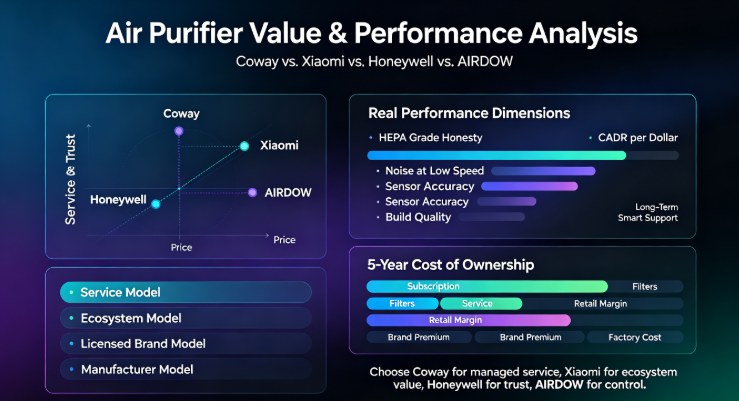
What Each Brand Actually Represents
Understanding the origin of each brand explains most of the differences in price, service, and target customer.
• Coway is a Korean air and water treatment specialist that built its position on a subscription and rental service model. In Korea and several Asian markets, the customer does not simply buy a purifier — they subscribe to a service that includes the unit, regular filter replacement, and periodic professional cleaning. That model changes everything: the hardware is designed for serviceability, the filter business is captured, and the customer relationship is recurring. The premium reflects the service, not just the appliance.
• Xiaomi built its position on ecosystem integration and aggressive price-to-specification ratios. The purifier is a node in a smart home platform, controlled from the same app as lighting and cameras, and sold at a price that made high-CADR filtration accessible to a much wider market. The trade-offs are familiar from every ecosystem product: fixed configurations, limited customization, app-dependent features, and a supply chain optimized for volume rather than for local service.
• Honeywell is an industrial and building technologies company whose name carries enormous credibility in air treatment, filtration, and safety equipment. In consumer air purifiers, branded products are produced through licensing and partner arrangements — a common structure in this category — which means the badge reflects a licensing relationship as much as a single factory. The consumer benefit is trust and distribution; the trade-off is that specification and sourcing vary more than the badge implies.
• AIRDOW operates on a different axis entirely: it is a manufacturer, not a consumer brand. Products are built to a buyer’s specification and sold either as private label or under the AIRDOW OEM brand. There is no consumer brand premium to fund, no rental infrastructure to amortize, and no ecosystem lock-in — but also no consumer brand recognition to borrow.
That fourth model is worth understanding in detail, because it behaves differently from the other three in every commercial respect. More on the AIRDOW OEM brand and manufacturing model below.
Positioning Comparison
|
Dimension |
Coway |
Xiaomi |
Honeywell |
| Origin / category | Korean air treatment specialist | Consumer electronics ecosystem | Industrial technology, licensed consumer range |
| Core strength | Service model, filtration R&D | Price-to-spec, smart integration | Brand trust, filtration heritage |
| Dominant channel | Rental / subscription, retail | E-commerce, ecosystem stores | Retail chains, commercial distribution |
| Price positioning | Premium | Value / aggressive | Mid to premium |
| Revenue model | Recurring subscription + filters | One-time sale + filters | One-time sale + filters |
| Customization for buyers | Very limited | Very limited | Limited, licence-dependent |
| Service depth | High (where rental exists) | Low to moderate | Moderate, market dependent |
| Best for | Buyers wanting managed service | Smart home users, value seekers | Risk-averse buyers, commercial spec |
Performance: The Dimensions That Actually Differ
Across all four offerings, the raw filtration technology converges more than marketing suggests. All can supply HEPA-grade media; all can achieve high single-pass efficiency; all can add carbon for gases. What genuinely differs is how well each executes on the surrounding dimensions.
• Filtration grade and honesty of claims. HEPA is a defined standard, not a marketing word: a true HEPA filter removes at least 99.97% of particles at 0.3 micron. Brands that publish the grade (H11, H13, H14) and the test standard are telling you something. Brands that publish only a percentage are not.
• CADR relative to price. This is where Xiaomi historically pressed hardest, and where factory-direct supply competes most directly. CADR per dollar is a measurable ratio, and it is the single most useful number when comparing products at different price points.
• Noise at real operating speeds. A unit rated for high CADR at a noise level nobody can tolerate in a bedroom is not delivering that CADR in practice. Compare sound levels at low and medium settings, not just maximum.
• Sensor quality and calibration. A PM2.5 sensor that reads low will keep the unit in low-speed mode and under-deliver. Sensor accuracy is rarely advertised and heavily affects real-world performance.
• Build quality and serviceability. Filter access, tool-free replacement, and durable housings matter enormously in rental and commercial use, and are the first things to be cut in a low-cost design.
• Smart features and long-term support. App control is only as good as the app’s lifespan. Ecosystem products tie functionality to a platform; a private-label product ties it to your own brand promise.
That first point is the one worth insisting on: 99.97% at 0.3 micron is a definition, not a claim, and it is set out plainly in the US EPA explanation of what a HEPA filter is. Any supplier unable to state which grade they use against which standard is telling you something by omission.
For all of these dimensions, the honest comparison method is to pull the test reports. The EPA guide to air cleaners is a useful primer on which claims are meaningful and which are decorative, and it is written for exactly the buyer who is trying to cut through specification marketing.
Five-Year Cost of Ownership Across Models
The purchase price difference between these four options is dramatic. The ownership cost difference is far smaller than it looks, because of how filters and service are priced into each model.
|
Cost Element |
Coway (rental) |
Xiaomi (retail) |
Factory-direct OEM |
| Upfront cost | Low or zero | Full retail price | Wholesale / FOB |
| Monthly / recurring | Subscription fee | None beyond filters | None beyond filters |
| Filter cost | Included in service | Retail filter pricing | At-cost or negotiated |
| Professional service | Included | Not included | Buyer’s responsibility |
| 5-year cash profile | Predictable, higher total | Lower total, lumpy | Lowest total, buyer-controlled |
| Exit cost | Contract terms apply | None | None |
| Best fit | Wants zero-hassle service | Wants low upfront cost | Wants control and margin |
The pattern is consistent across the category: rental models trade a higher lifetime total for predictability and zero effort; retail models trade service for a lower total; factory-direct supply trades brand comfort and consumer recognition for the lowest total and the most control. None of these is wrong. They are different purchases.
For a distributor, the same logic applies at a different scale. A rented or branded product carries a fixed margin; a private-label product carries whatever margin the market will bear, plus the filter revenue, minus the brand-building cost. That trade is the core decision in building a private-label program and it deserves a spreadsheet rather than a preference.
Where the Brand Premium Is Genuinely Justified
A fair analysis has to concede the cases where paying more is the rational choice. In our experience supplying buyers who compete against these brands, the premium is justified when:
• The buyer wants managed service and will not maintain filters themselves. Coway’s model exists because most households genuinely do neglect filter replacement. Paying someone to handle it has real value.
• The buyer wants ecosystem integration as a primary feature. If the purifier must coordinate with existing smart home devices, platform compatibility is worth something tangible.
• The buyer is risk-averse about after-sales and needs a brand name to justify the purchase internally — procurement committees accept familiar names more readily than factory names.
• The buyer needs commercial specification credibility. In tenders, an industrial brand with filtration heritage can carry a submission that a private label cannot, regardless of the underlying hardware.
• The buyer values resale or rental market acceptance. In markets where branded products retain value or rent more easily, the badge is an asset.
Where the Premium Buys Little
• Raw filtration performance. At equal HEPA grade and equal CADR, the delivered air quality is equivalent. The premium is not buying cleaner air; it is buying the surrounding service and assurance.
• Filter media quality. The global HEPA media supply base is concentrated. A well-specified factory product uses media from the same or equivalent suppliers.
• Build durability in normal use. Tier-one factories build for multi-year residential duty. The gap appears in consistency and documentation discipline, both of which are contractual, not national.
• Energy efficiency at low speed. Modern brushless DC platforms are widely available; the efficiency difference between brands at comparable specifications is small.
• Basic smart features. WiFi control, scheduling, and air quality display are commodity capabilities now, available through established module ecosystems at low cost.
The Factory-Direct Position: What AIRDOW Changes
Positioning a manufacturer against three consumer brands is not a claim that factories are better than brands. It is a claim about where the money goes.
In a branded product, a substantial share of the retail price funds brand building, retail margin, distribution layers, and the service infrastructure behind the badge. In a factory-direct program, that share stays with the buyer as margin, or is reinvested into higher specification at the same price. A buyer can specify a higher filter grade, a better motor, or a more accurate sensor for the same spend — which is precisely what OEM air purifier programs are designed to enable.
• Specification control. Choose the filter grade, the sensor, the motor platform, the voltage, the plug type, the housing, and the packaging. Brands sell fixed configurations; factories sell configurations.
• Margin control. Landed cost is set by negotiation and volume, not by a brand’s global price architecture. The buyer sets retail price with full knowledge of their own cost base.
• Consumable revenue. Filter sales belong to the brand owner, not to a third party. This is the single largest structural difference from a rental or licensed model.
• Market-specific adaptation. Voltage, certification, language, and design preferences can be built in per market rather than accepting a global SKU.
• Portfolio breadth. A single supplier relationship can cover residential units, commercial and project-grade equipment, ventilation and fresh-air systems, and car air purifiers.
• Documentation as standard. Test reports, certification files, and installation documentation are part of the commercial relationship rather than a negotiation.
In practice that breadth matters more than buyers expect. A distributor that starts with residential purifiers often adds commercial and project-grade units within a year, then ventilation and fresh-air systems and car air purifiers as the customer base broadens. Sourcing all of it from one manufacturer removes an entire layer of supplier management.
The trade-off is equally real: a factory does not bring consumer demand with it. Building a brand means investing in marketing, distribution, and after-sales capability that a licensed or rental model provides out of the box. Buyers who underestimate that investment are the ones who conclude, wrongly, that private label does not work. The residential purifier line is a good illustration: the hardware is straightforward to source, but the brand around it is the buyer’s work.
Regional Reality: Brand Strength Is Not Global
One correction to any brand comparison written in English: these three brands are not equally strong everywhere, and a comparison that treats them as globally comparable misleads buyers in most markets outside the United States and Korea.
• Korea and parts of East Asia — The rental and subscription model is deeply established for air and water appliances, and it shapes consumer expectations. A Coway-type proposition competes on service quality and contract terms as much as on hardware, and a retail-only product struggles to displace it in the household segment.
• China and much of Southeast Asia — Ecosystem value pricing dominates the consumer conversation. Buyers compare specifications against price in a way that favours aggressive value brands, and the local competitive field is crowded with manufacturers selling directly.
• North America and Western Europe — Retail and e-commerce channels favour familiar names and verified performance claims. Consumer trust is anchored to brands with visible retail presence and published AHAM-style CADR data.
• Middle East, Africa, and emerging markets — Distribution relationships decide more than brand equity. A brand with no local service partner is worth less than a well-supported private label with spare parts on the shelf.
• Institutional and project channels everywhere — A filtration heritage name carries real weight in tender documents and procurement sign-off, even where the manufacturing behind the badge is outsourced.
The commercial conclusion is that brand value is a local asset, not a global constant. A buyer comparing brand options for a specific market should ask which of these propositions the local customer base actually responds to, then choose accordingly — including the option of building a local proposition rather than importing one. That calculation often ends up spanning both air treatment and fresh-air ventilation systems, because the same customer buying filtration is usually buying fresh air too.
For buyers who conclude that a project or tender channel is the primary route in their market, the comparison shifts again: what matters there is certification completeness, project-grade commercial air purifiers with documented duty ratings, and installation support. Brand recognition helps less than a complete certification file.
Who Should Choose What
|
Situation |
Rational Choice |
| Household wanting zero maintenance | Rental / subscription model (Coway-type) |
| Smart home user, price-conscious | Ecosystem brand (Xiaomi-type) |
| Procurement committee needs a familiar name | Industrial brand (Honeywell-type) |
| Distributor launching own brand | Factory-direct private label |
| Retailer wanting exclusive SKUs | Factory-direct private label |
| Project/tender supply | Factory-direct with full certification file |
| Small first order to test a market | Factory-direct, low MOQ platform |
| Buyer with no after-sales capability | Brand or rental — not private label |
How to Verify Any of These Brands Before Buying
Regardless of which route you choose, the verification checklist is the same, and it is what separates a good purchase from an expensive lesson:
1. Confirm the HEPA grade and the test standard behind it. H11, H13, or H14 against EN 1822, or a stated efficiency at a stated particle size.
2. Check CADR with its test conditions. Room size claims should be derivable from CADR, not from a marketing figure.
3. Ask for sound level at low speed. If it is not published, request it — an unlisted low-speed noise figure usually means it is not good.
4. Verify the filter is available and priced. A purifier with expensive or disappearing filters has a hidden cost curve.
5. Confirm the certificate matches the model and the manufacturer entity. This applies equally to brands and factories.
6. Read the fine print on app support. Ecosystem products can lose features if the platform changes.
7. For private label, lock the specification in writing. Sample drift and component substitution are the two failure modes to design against.
Particle size is worth understanding before any of these conversations, because it determines what the product is actually for. The EPA overview of indoor particulate matter explains why the finest fractions carry the greatest health relevance, and why a filter’s performance at 0.3 micron is the number that matters.
Conclusion: Different Products for Different Buyers
1. Coway sells managed service, Xiaomi sells ecosystem value, Honeywell sells trust and heritage, and factory-direct supply sells control and margin — these are four different purchases, not four versions of one
2. Filtration technology converges at comparable specifications; the real differences sit in service model, sensor quality, serviceability, and long-term app support
3. Five-year cost of ownership narrows the price gap considerably — rental models are predictable but higher, retail models are lower, factory-direct is lowest and most buyer-controlled
4. The brand premium is justified when you need managed service, ecosystem integration, procurement comfort, or tender credibility — and buys little when you simply need filtration performance
5. Private label delivers the best economics but requires brand investment and after-sales capability; buyers who skip that step misdiagnose the model as unworkable rather than underfunded
Evaluating a factory-direct program against established brands? See our manufacturing capability or contact our export team at ada5@airdow.com for specifications and pricing.
References and Further Reading
US EPA — What is a HEPA filter?
US EPA — Guide to Air Cleaners in the Home
US EPA — Indoor Particulate Matter
US EPA — Improving Indoor Air Quality
Post time: Nov-20-2026


