
Two filtration technologies dominate the commercial air purifier market, and they work on completely opposite principles. HEPA filters physically trap particles in a dense fiber matrix. Electrostatic precipitators (ESP) charge particles electrically and collect them on metal plates. Both can achieve high single-pass efficiency. They differ enormously in what they cost to own, what they demand from the user, and which markets accept them.
For B2B buyers, this is not an academic question. Choosing between HEPA and ESP determines your consumable revenue model, your after-sales support burden, your certification strategy, and in some markets your legal exposure. A distributor who stocks the wrong technology for a region can be stuck with inventory that regulators or customers will not accept.
This comparison covers both technologies on the dimensions that matter in a purchasing decision: filtration mechanism, verified efficiency, total cost of ownership over five years, maintenance reality, ozone and safety considerations, and market positioning. It also covers how our OEM air purifier programs handle hybrid configurations that combine the strengths of each.
What HEPA Filtration Actually Does
HEPA stands for high-efficiency particulate air. As defined by the U.S. Department of Energy and described by the US EPA, a true HEPA filter removes at least 99.97% of particles at 0.3 micron — the most penetrating particle size (MPPS), where filters are weakest. Particles both larger and smaller than 0.3 micron are captured with higher efficiency, which is why HEPA performance is quoted at that specific size.
The mechanism is mechanical and passive. Air is forced through a pleated borosilicate or synthetic fiber mat, and particles are captured by four effects: interception, impaction, diffusion, and electrostatic attraction within the media. There is no charging, no high voltage, and no ozone by-product. Once captured, particles stay captured until the filter is replaced.
The trade-off is airflow resistance. A dense HEPA media creates significant pressure drop, so HEPA purifiers need a more powerful fan to deliver the same clean air delivery rate (CADR) as an ESP unit. That resistance is the source of most HEPA operating cost, and it is also why filter replacement is unavoidable — loaded media increases pressure drop further until the motor can no longer move design airflow.
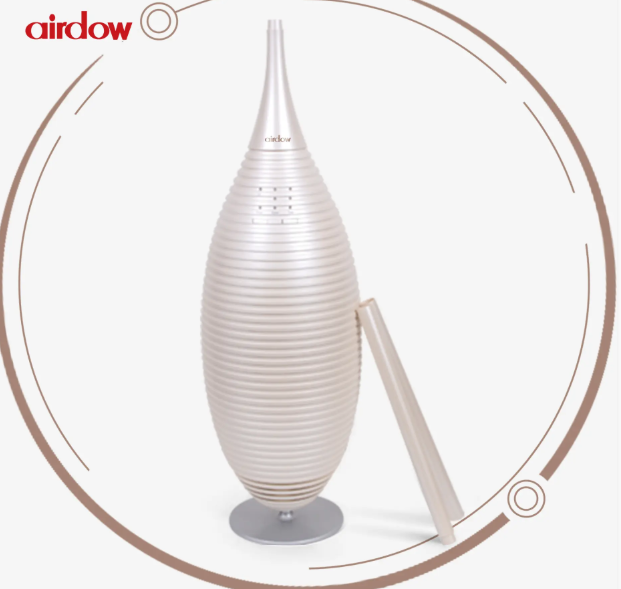
In the AIRDOW home air purifier range, HEPA H13 media is paired with a pre-filter stage specifically to protect the HEPA from coarse dust and extend its service life. This is the standard configuration for residential use and for any market with strong allergy or PM2.5 awareness.
What Electrostatic Precipitation Actually Does
ESP works by electricity rather than by physical capture. Air passes through an ionizing section where particles receive an electric charge, then through a collector section of alternating grounded and high-voltage plates. Charged particles are driven onto the plates and held there by electrostatic force.
Because the collection field is open rather than dense, ESP units have very low airflow resistance. This is their defining advantage: high airflow, low fan power, high CADR per watt. A washable metal collector plate assembly can also be cleaned and reused indefinitely — no consumable filter media at all.
The trade-offs are equally specific. Efficiency depends on field strength and particle charge, and typically falls off for the smallest particles and for particles with low chargeability. Collection efficiency also degrades continuously as plates load with dust, then recovers sharply after cleaning — a sawtooth performance profile rather than the gradual decline of a HEPA filter.
The most important consideration is ozone. Corona discharge in the ionizing section can generate ozone as a by-product. This is why the technology is regulated in several jurisdictions and why the EPA guide to air cleaners treats ozone generation as a specific consumer caution. Well-engineered ESP units with carbon post-filters keep ozone output low, but unverified high-voltage designs are a genuine compliance risk.
Head-to-Head Comparison
|
Dimension |
HEPA |
ESP (Electrostatic) |
Edge |
| Mechanism | Mechanical capture in fiber media | Electric charge + plate collection | — |
| MPPS efficiency | 99.97%+ at 0.3 µm (H13) | 90-98% typical, size dependent | HEPA |
| Sub-micron particles | Excellent (diffusion effect) | Weaker below 0.1 µm | HEPA |
| Airflow resistance | High | Very low | ESP |
| Power per unit CADR | Higher | Lower | ESP |
| Consumable cost | Filter replacement required | Washable plates, no media | ESP |
| Performance over time | Gradual decline | Sawtooth, recovers after cleaning | HEPA |
| User maintenance | Replace filter 1-2x/year | Wash plates every 2-4 weeks | HEPA |
| Ozone risk | None | Possible without careful design | HEPA |
| Noise | Higher at design airflow | Lower (less fan load) | ESP |
| Regulatory acceptance | Universal | Restricted in some markets | HEPA |
| B2B revenue model | Recurring filter sales | One-time sale + service | HEPA |
Verifying Efficiency: Which Test Standards to Demand
Efficiency claims are meaningless without a stated test method. Four standards matter in this category, and buyers should ask which one a supplier’s data actually comes from:
• EN 1822 — The European standard for HEPA and ULPA filters. H13 requires 99.95% efficiency at MPPS, H14 requires 99.995%. Widely referenced in European and export-oriented product documentation.
• ISO 16890 — The current international standard for general ventilation filters, rating performance by PM1, PM2.5, and PM10 fractions rather than a single efficiency figure. More relevant to real-world health outcomes than legacy ratings.
• ASHRAE 52.2 / MERV — The North American filter rating system. MERV 13-16 covers higher-efficiency applications; HEPA-class performance sits above the MERV scale entirely.
• AHAM CADR — The US industry verification program for portable air cleaners, measuring clean air delivery rate in cubic feet per minute for smoke, dust, and pollen. This is the number that should drive room sizing claims.
For buyers evaluating ESP products, insist on particle-count data at multiple particle sizes rather than a single headline efficiency figure, plus a measured ozone output in ppm. The EPA background on indoor particulate matter explains why size fraction matters: particles below 2.5 micron penetrate deep into the respiratory tract, so efficiency at 0.3 micron is the number that has health relevance.
Total Cost of Ownership Over Five Years
The purchase price is the least interesting number in this comparison. Here is how the two technologies compare over a five-year ownership period for a single commercial-grade unit in continuous operation:
|
Cost Element |
HEPA Unit |
ESP Unit |
Notes |
| Purchase price | $300-800 | $250-600 | ESP often cheaper at equal airflow |
| Filter / media cost (5 yr) | $150-400 | $0 | HEPA filters 1-2x per year |
| Electricity (5 yr) | $180-450 | $90-250 | ESP lower pressure drop |
| Cleaning labour (5 yr) | Minimal | $200-600 | ESP plates need regular washing |
| Carbon post-filter | Optional | Recommended | For ozone and odour control |
| Estimated 5-yr total | $630-1,650 | $540-1,450 | Depends heavily on labour cost |
Note the labour line. In markets with low labour cost, ESP’s washable design is a genuine advantage. In markets with high labour cost — or in installations where cleaning is likely to be neglected — the labour burden dwarfs the filter savings, and HEPA’s replace-and-forget model often wins on real-world performance.
That neglect factor is the decisive hidden variable. An ESP unit that is not cleaned loses efficiency progressively; a district manager with twelve buildings and no cleaning schedule will end up with twelve underperforming ESP units. HEPA degrades too, but its decline is slower and a filter indicator gives an unambiguous signal.
Maintenance Reality and Operational Risk
• HEPA maintenance is a consumable swap. A trained staff member replaces a cartridge in minutes, and performance resets to specification. No skill and no judgement are required, which is why HEPA is the default for schools, clinics, and multi-site commercial portfolios.
• ESP maintenance is a washing procedure. Collector plates must be removed, washed, dried, and refitted — typically every two to four weeks in heavy use. If plates are refitted wet or misaligned, arcing and reduced performance follow.
• ESP ionizing wires are delicate. Broken or fouled emitter wires are the most common ESP failure mode, and they are also the component most likely to increase ozone output when damaged.
• HEPA has no electrical failure mode. The only failure is a loaded filter, which is visible and predictable.
• Spare parts availability matters more for ESP. Washable plates sound maintenance-free in a brochure, but replacement plate assemblies and ionizer wires must be stocked for the installed base.
Ozone and Certification: The Detail That Decides Deals
Ozone is where the HEPA versus ESP conversation becomes a legal question rather than a technical one. Ozone is a respiratory irritant, and devices that intentionally or incidentally generate it are regulated in a growing number of jurisdictions. For ESP products, the ionizing stage is the source, and the design decisions that control it are specific:
• Emitter design — Carbon-fiber brush emitters and controlled corona geometries produce far less ozone than sharp-needle designs running at high voltage. The emitter is the component to interrogate first.
• Voltage regulation — Stable high-voltage supply limits peak discharge. Cheap unregulated supplies are the usual cause of elevated ozone in low-cost ESP units.
• Carbon post-filtration — A carbon stage downstream of the collector adsorbs residual ozone as well as odours. This is the most common and most cost-effective mitigation.
• Measured output, not claimed output — Demand a third-party ozone test report stating the concentration in ppm at the breathing zone. A figure without a test method is not evidence.
• Regulatory thresholds — Several markets cap ozone output for air cleaning devices sold to consumers. Selling an unverified ESP unit into those markets creates recall and liability exposure, not just a compliance fine.
HEPA products sidestep this entire conversation. That is precisely why HEPA is the safer default for schools, clinics, and any tender where an auditor will ask for documentation. The technology generates no by-product, so the certification file is shorter, the review is faster, and the sales cycle is less exposed to a late-stage compliance question.
Market Positioning: Where Each Technology Sells
|
Market / Channel |
Technology Fit |
Reason |
| North America, Western Europe | HEPA | Ozone sensitivity, AHAM CADR expectations, allergy marketing |
| China, Korea, Japan | HEPA + hybrid | HEPA dominant; ESP appears in low-cost and high-airflow segments |
| Southeast Asia | Both | Price sensitivity favours ESP entry models |
| Schools, clinics, hospitals | HEPA | Zero ozone tolerance, audit-friendly maintenance |
| Industrial, workshop, welding | ESP | High airflow and heavy particulate loads |
| Restaurants, KTV, smoking areas | ESP + carbon | High airflow, odour load, tolerant of maintenance regimes |
| Data centres, HVAC retrofits | ESP / hybrid | Low pressure drop is decisive in ducted systems |
Reading across those rows, a pattern emerges: HEPA dominates wherever the buyer is health-sensitive or the maintenance regime is uncertain, while ESP holds the segments where airflow, particulate volume, and cost per cubic metre of treated air decide the purchase. Buyers building a portfolio often end up carrying both — see the commercial air purifier range for the heavy-duty side of that mix.
Decision Framework for Product Line Planning
✓ Choose HEPA when: your market has ozone sensitivity or regulation, you sell on allergy or health claims, your customers have limited maintenance capability, or you want recurring filter revenue.
✓ Choose ESP when: airflow-to-power ratio is the sales driver, particulate loads are heavy and non-hazardous, labour cost is low, and you can support a cleaning regime with real documentation.
✓ Choose hybrid when: you need high airflow with defensible air quality claims. An ESP collection stage followed by a carbon filter and a polishing HEPA stage covers particulates, odours, and ozone in one product.
✓ Do not choose ESP without verified ozone data. This is the single most common compliance failure in the category, and it is avoidable — a measured output figure and third-party certification resolve it.
✓ Match technology to service capability, not to the catalogue. The best technology for your market is the one your customers can actually maintain.
AIRDOW supplies both configurations — HEPA-based units for residential and health-sensitive channels, and washable ESP designs for commercial air purifier projects with heavy particulate loads. For buyers building a multi-category portfolio, the air ventilation systems range complements either choice where CO2 and fresh-air delivery are also a requirement.
What This Means for Your Buy Decision
The HEPA versus ESP decision is not a contest with a winner. It is a matching exercise between technology characteristics and market requirements. Three practical implications for B2B buyers:
• Recurring revenue is a strategic choice, not a side effect. HEPA gives you filter consumables; ESP gives you a one-time sale plus a service relationship. Both are legitimate business models, but they require different organisational investment.
• Certification burden differs. HEPA travels across borders with minimal friction because it generates no by-products. ESP needs ozone documentation and, in some markets, specific approvals.
• The neglect risk is under-priced. Every ESP product sold to a customer without the capability to maintain it becomes a performance complaint. Every HEPA product sold has a predictable consumable lifecycle.
Buyers who want to understand the manufacturing and quality context behind these claims can review our factory history and production capability or the overview of how we supply air purifier programs long term. Vehicle applications follow the same logic at smaller scale — see the car air purifier range for compact HEPA and ion configurations.
Conclusion: Match the Technology to the Market
1. HEPA achieves 99.97% removal at the 0.3 micron MPPS with no by-products; ESP achieves high airflow at low power but with size-dependent efficiency and an ozone consideration
2. Five-year total cost of ownership is closer than marketing suggests — ESP saves on filters and electricity but spends on cleaning labour and service support
3. ESP’s real risk is the neglect factor: uncleaned plates degrade silently, whereas a loaded HEPA filter produces an unambiguous replacement signal
4. Regulatory acceptance, not performance, is often the deciding factor — ozone documentation and certification requirements favour HEPA in health-sensitive and ozone-regulated markets
5. Hybrid designs (ESP collection + carbon + HEPA polish) resolve most of the trade-off where high airflow and defensible air quality are both required
AIRDOW builds both configurations to order. See the full OEM air purifier program or contact us at ada5@airdow.com for efficiency test reports, ozone documentation, and product specifications.
References and Further Reading
US EPA — What is a HEPA filter?
US EPA — Guide to Air Cleaners in the Home
US EPA — Indoor Particulate Matter
US EPA — Introduction to Indoor Air Quality
Post time: Nov-03-2026


