
That new car smell is not a sign of quality. It is a chemical signature — a mixture of volatile organic compounds off-gassing from the materials the cabin is built from.
Every new vehicle contains adhesives, sealants, plasticizers, foams, coatings, and synthetic textiles. For the first several months of the vehicle’s life, these materials release volatile organic compounds (VOCs) into the cabin air. The most widely studied of these is formaldehyde, a known irritant and a classified carcinogen. Because a cabin is a small, sealed volume that heats up dramatically in sunlight, concentrations of these compounds can be several times higher inside a new car than in a typical indoor space.
This article explains where new-car VOCs come from, how long they persist, and how modern air purifiers — particularly those combining activated carbon with HEPA filtration — accelerate their removal. It also covers what buyers and OEM suppliers should verify before making health claims.
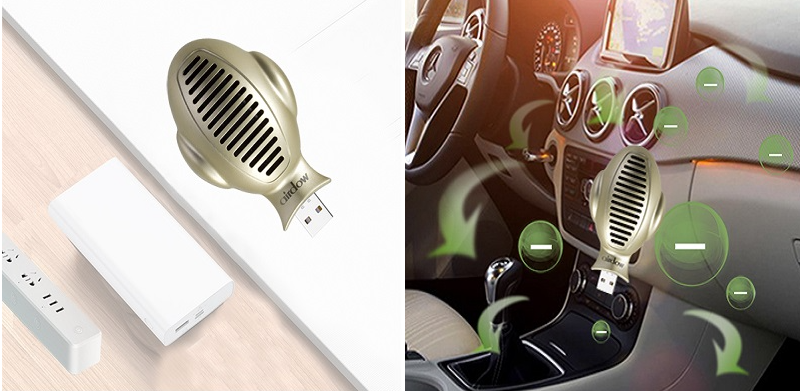
Where New-Car VOCs Come From
• Adhesives and sealants — The largest single source. Formaldehyde-based and solvent-based adhesives used in trim bonding, carpet backing, and panel assembly release VOCs continuously for months.
• Foam and padding — Seat foam and headliner padding use blowing agents and plasticizers that emit toluene, xylene, and related compounds.
• Plastics and coatings — Dashboard, door panels, and console surfaces outgas residual monomers and plasticizers, especially when heated.
• Textiles and leather treatments — Fabric dyes, flame retardants, and leather tanning and finishing agents contribute additional VOC load.
• Heat accelerates everything — Emission rates rise sharply with temperature. A cabin parked in summer sun can reach 60-70 degrees Celsius, multiplying off-gassing rates several times over and trapping the products inside.
• The new-car smell itself — Perceived as pleasant by many buyers, but it is simply the perceptible fraction of these emissions. A strong smell generally indicates a higher emission load.
Formaldehyde: The Compound That Matters Most
Formaldehyde deserves separate treatment because it is the most regulated and most studied cabin VOC:
|
Property |
Detail |
| Chemical nature | Smallest aldehyde; highly volatile; released from urea-formaldehyde and melamine resins |
| Typical cabin levels | Highest in the first 3-6 months of vehicle life; strongly temperature dependent |
| Health effects | Eye, nose, and throat irritation at low levels; classified carcinogen with long-term exposure |
| Sensitive groups | Children, pregnant occupants, asthma sufferers, and people with chemical sensitivity |
| Regulatory context | Regulated in building materials and increasingly in vehicle interiors in several markets |
| Emission decay | Concentrations decline gradually over months, but low-level release can continue for years |
How Air Purifiers Reduce Formaldehyde and VOCs
Three mechanisms matter in a vehicle cabin, and only two of them are effective for gaseous pollutants:
• Activated carbon adsorption — The primary effective technology. Formaldehyde and other VOC molecules bind to the vast internal surface area of activated carbon (typically 800-1,500 m² per gram). This physically removes the molecule from the air stream. This is what actually reduces gas concentrations.
• Catalytic oxidation — Certain catalysts (including some cold catalyst and photocatalyst formulations) break down formaldehyde into carbon dioxide and water at room temperature. Effectiveness depends heavily on contact time and catalyst quality; claims should be supported by test data.
• HEPA filtration — Excellent for particles and for the particulate-bound fraction of some compounds, but HEPA media does not capture gas molecules. A HEPA-only purifier will not meaningfully reduce formaldehyde.
• What does not work well — Ionizers and ozone generators. Ionizers act on particles, not gas molecules. Ozone generators can react with VOCs but produce ozone, itself a lung irritant, and are not appropriate for occupied spaces.
• The carbon quantity question — Effective gas removal requires a meaningful mass of carbon. Very thin carbon layers in compact units saturate quickly and stop working — a key performance difference between products.
How Fast Can Purifiers Reduce Cabin VOCs?
Speed depends on three variables: the source emission rate, the purifier’s clean air delivery rate for gases, and cabin volume. Here is what realistic expectations look like in a 3-4 m³ cabin:
|
Timeframe |
Expected Change |
Key Driver |
| 0-30 minutes | Perceptible odor reduction with a strong carbon unit running | Airborne fraction adsorbed |
| 30-120 minutes | Measurable reduction in airborne formaldehyde/VOC concentration | Carbon CADR vs cabin volume |
| 2-8 hours | Concentration approaches the lowest level the purifier can sustain | Reaching equilibrium with ongoing emissions |
| Ongoing | Concentration held at a lower steady state while emissions continue | Source continues, purifier continuously works |
| Long term | Emissions themselves decline over months regardless of purification | Natural material ageing |
The important insight: a purifier does not eliminate the source. It establishes a lower equilibrium concentration by removing molecules as fast as the interior releases them. Turning the purifier off allows concentrations to climb back toward the untreated level.
Practical Steps to Protect Occupants
1. Ventilate aggressively at first — During the first weeks of ownership, drive with windows partly open or on fresh-air mode. Dilution remains the fastest way to reduce concentrations.
2. Park in shade, and ventilate before entering — Interior temperature drives emission rates more than anything else. Opening the doors for a minute before entering clears the accumulated peak.
3. Run the purifier on recirculation with the cabin fan on — Gas removal requires air to pass through the carbon media. Without airflow, the purifier only treats air in its immediate vicinity.
4. Choose a unit with substantial carbon mass — Compare carbon weight, not just the presence of a carbon layer. Thin carbon saturates in weeks under new-car emission loads.
5. Replace carbon media on schedule — Saturated carbon becomes ineffective and can release previously adsorbed compounds under heat. In a new vehicle, expect faster replacement intervals.
6. Use fresh-air mode periodically — New car interiors also benefit from the vehicle’s own ventilation. Fresh-air mode replaces cabin air with filtered outside air, which may itself be cleaner than the cabin.
7. Avoid perfumed and ozone products — Fragrance masks the smell without reducing the hazard; ozone adds a second irritant to an already loaded space.
Verifying Claims: What Buyers Should Demand
✓ Chamber test data — Credible formaldehyde and VOC removal claims come from controlled chamber tests reporting starting concentration, test duration, and final concentration. A single efficiency percentage without test conditions is not verifiable.
✓ Specific compounds — Look for named target compounds (formaldehyde, toluene, TVOC) rather than generic gas removal claims. Different molecules have very different adsorption behaviour.
✓ Carbon mass stated in grams — This is the single most predictive specification for gas removal performance and service life.
✓ Test method transparency — Reference to a recognized standard (chamber, GC-based quantification) indicates a supplier that has actually tested the product.
✓ No health claims without evidence — Marketing that implies medical protection (asthma prevention, allergy cure) exceeds what any air purifier can substantiate and invites regulatory problems in most markets.
B2B Perspective: The New-Car Segment
• A defined purchase moment — New vehicle purchase is a rare moment when buyers actively think about cabin air. Products that solve the new-car VOC problem have a natural sales trigger.
• Natural bundling — New-car air purifiers pair with vehicle delivery packages, dealership accessory programs, and fleet onboarding kits.
• Health-positioned markets — Demand is strongest where consumers are already alert to formaldehyde (notably China and parts of Southeast Asia), making cabin VOC removal a well-understood selling proposition.
• Specification differentiation — In a crowded accessory category, carbon mass, chamber test data, and replacement filter availability are the specs that let a supplier defend a higher price.
• Product design implications — Units intended for new vehicles benefit from higher carbon loading, larger filter faces, and clear replacement indicators, because emission loads are highest when the product is first used.
Conclusion: Manage the Source, Then Filter the Air
1. New car cabins release formaldehyde and other VOCs from adhesives, foams, plastics, and textiles — with emissions sharply amplified by heat
2. Activated carbon adsorption is the technology that actually removes gaseous formaldehyde and VOCs; HEPA handles particles, and ionizers do not address gases
3. A purifier lowers cabin concentrations to a new, lower equilibrium while emissions continue — it reduces exposure but never eliminates the source
4. Ventilation, shade parking, and running the purifier on recirculation with the cabin fan on are what produce measurable reductions fastest
5. For buyers, carbon mass in grams, named target compounds, and chamber test data are the only claims worth trusting
Building a vehicle air purification product for the new-car market? Contact us at ada5@airdow.com for carbon-loaded filter specifications, chamber test documentation, and OEM program support.
Post time: Oct-14-2026


