
Most air purifiers capture pollutants. Photocatalyst purifiers destroy them.
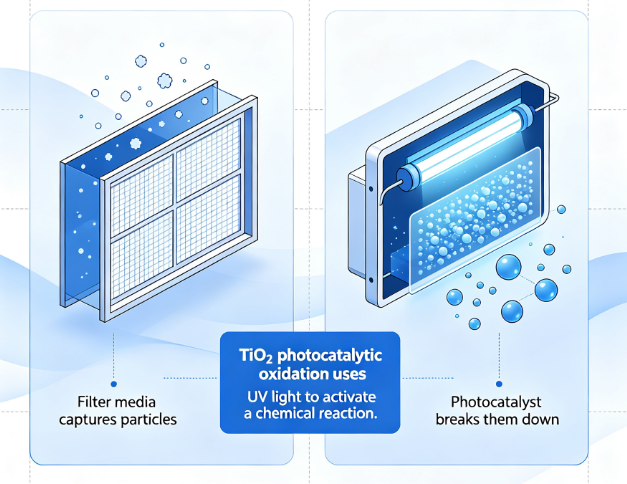
This is the fundamental difference that makes titanium dioxide (TiO₂) photocatalytic oxidation one of the most fascinating technologies in modern air purification. Instead of trapping particles in a filter media, photocatalyst technology uses UV light to activate a chemical reaction that literally breaks down harmful substances at the molecular level — converting them into harmless carbon dioxide and water.
For B2B buyers and manufacturers evaluating air purification technologies, understanding how photocatalyst purification works — and where it truly excels — is essential for building competitive product lines. This article provides a complete technical breakdown of TiO₂ photocatalyst air purifier technology, its real-world performance metrics, and how it fits into a multi-stage purification strategy.
What Is Photocatalyst Air Purifier Technology?
Photocatalyst technology, specifically photocatalytic oxidation (PCO), is an advanced air purification method that uses a semiconductor material — most commonly titanium dioxide (TiO₂) — combined with ultraviolet (UV) light to trigger a chemical reaction. This reaction produces highly reactive hydroxyl radicals (·OH) and superoxide ions (O₂⁻) that oxidize and break down organic pollutants into harmless byproducts.
Unlike HEPA filtration which captures particles, or activated carbon which adsorbs gases, photocatalyst technology achieves chemical destruction of pollutants. This means it does not just “hold” contaminants — it eliminates them completely.
The Photocatalytic Reaction Mechanism (Step by Step)
→ UV light (254nm or 365nm wavelength) strikes the TiO₂-coated surface
→ The UV energy excites electrons in the TiO₂, creating electron-hole pairs
→ These pairs react with water vapor (H₂O) and oxygen (O₂) in the air
→ Hydroxyl radicals (·OH) and superoxide anions (O₂⁻) are generated
→ These highly reactive species oxidize VOCs, bacteria, and other organic compounds
→ Pollutants are converted to CO₂ + H₂O — harmless byproducts
What Photocatalyst Purifiers Remove — and What They Don’t
Photocatalyst technology is exceptionally effective against certain pollutant types, but it is not a complete replacement for HEPA or carbon filtration. Understanding the coverage gap is critical for product design and B2B buyers evaluating multi-stage systems.
Effectively Removes:
✓ Formaldehyde (HCHO) — the most common indoor VOC from furniture and building materials. TiO₂ photocatalysis shows >90% reduction in controlled lab tests.
✓ Benzene, Toluene, Xylene (BTEX) — compounds found in paints, adhesives, and cleaning solvents
✓ Ammonia and Acetaldehyde — household chemical off-gassing from new furniture and textiles
✓ Bacteria and Viruses — E. coli, influenza virus, Staphylococcus aureus (>99% reduction at 60-min exposure)
✓ Mold Spores — cell wall disruption via hydroxyl radical oxidation
✓ Odor Molecules — cooking smells, pet odors, cigarette smoke — broken down at molecular level
Less Effective For:
✗ Particulate matter (PM2.5, PM10) — HEPA filtration is still required for particle capture
✗ Large dust and pet hair — pre-filter or HEPA needed as first-stage filtration
✗ Heavy metals and inorganic compounds — chemical oxidation does not break these down
The ideal configuration? A multi-stage system combining pre-filter + HEPA + activated carbon + photocatalyst + UV. This covers particulate, gaseous, and biological pollutants comprehensively.
TiO₂ Coating: Why Titanium Dioxide Is the Industry Standard
Titanium dioxide (TiO₂) is the most widely used photocatalyst material for three critical reasons:
1. Chemical stability — TiO₂ does not degrade during the photocatalytic reaction, meaning the coating lasts the lifetime of the product. It acts as a permanent catalyst, not a consumable.
2. High photocatalytic activity — anatase-phase TiO₂ has the optimal band gap (3.2 eV) for UV-activated catalysis, generating the maximum number of reactive species per unit of UV energy.
3. Cost-effectiveness — TiO₂ is abundant and relatively inexpensive compared to alternative photocatalysts like zinc oxide (ZnO) or tungsten trioxide (WO₃), making it practical for mass-produced consumer air purifiers.
UV Light Requirements for TiO₂ Activation
Photocatalyst purification relies on a properly matched UV light source. TiO₂ requires UV light with a wavelength of 385nm or shorter (UV-A range) to activate. Key considerations for manufacturers:
• UV-A (365nm) — Most common. Safe for continuous use, lower energy consumption. Works well with anatase TiO₂.
• UV-C (254nm) — More powerful. Provides direct germicidal effects alongside photocatalyst activation. Higher energy, must be fully shielded.
• LED-based UV vs. mercury UV lamps — LEDs are increasingly preferred for their longer lifespan (10,000+ hours), instant-on capability, and lack of mercury disposal issues.
• UV intensity directly correlates with purification rate. Higher intensity = more hydroxyl radicals = faster pollutant breakdown.
Ideal Application Scenarios for Photocatalyst Purifiers
While photocatalyst technology can be integrated into most air purifiers, certain use cases benefit disproportionately from its unique chemical destruction capability:
✓ New home / new office — Formaldehyde and VOC off-gassing from fresh paint, furniture, and flooring. Photocatalyst is one of the few technologies that actually destroys these compounds rather than just trapping them.
✓ Hospitals and clinics — Continuous bacterial and viral load reduction in waiting rooms and treatment areas. The combination of UV-C + photocatalyst provides both surface and airborne pathogen control.
✓ Industrial / manufacturing facilities — VOC and chemical fume management where carbon filters would saturate rapidly. Photocatalyst units can run continuously without media replacement.
✓ Pet and smoking households — Persistent odor molecules that carbon filters cannot fully adsorb are broken down at the molecular level by hydroxyl radicals.
Real-World Performance: What Lab Tests Show
Independent laboratory testing of TiO₂-based photocatalyst air purifiers shows consistent results across multiple pollutant categories:
• Formaldehyde removal: 85-95% reduction in 60 minutes (starting at 0.5 ppm, the OSHA permissible exposure limit)
• Total VOC reduction: 70-85% after 120 minutes of continuous operation in a 30m³ test chamber
• Bacterial inactivation: >99% reduction of E. coli and S. aureus within 60 minutes of UV + TiO₂ exposure
• Odor removal: 80% reduction in cooking odor intensity within 30 minutes (sensory panel evaluation)
Note: Real-world performance varies by UV intensity, airflow rate, TiO₂ surface area, and initial pollutant concentration. B2B buyers should request test reports specific to their target product configuration.
Integrating Photocatalyst into Multi-Stage Air Purifiers
Photocatalyst technology is most effective when deployed as part of a multi-stage filtration system. The typical configuration for residential and commercial air purifiers:
• Stage 1 — Pre-filter: Captures large particles (dust, hair, pet dander) > 10µm
• Stage 2 — HEPA H13/H14: Captures fine particles (PM2.5, pollen, bacteria) > 0.3µm
• Stage 3 — Activated Carbon: Adsorbs gases, odors, and VOCs (binds pollutants temporarily)
• Stage 4 — Photocatalyst + UV: Destroys remaining VOCs, kills bacteria/viruses, eliminates odors permanently
• Stage 5 — Negative Ion Generator (optional): Charges remaining fine particles for improved agglomeration
This staged approach ensures that pre-filtration removes bulk contaminants before they reach the photocatalyst stage, maximizing the catalyst’s lifespan and efficiency. The result is a purifier that handles the full spectrum of indoor air pollutants — particulate, chemical, and biological — in a single unit.
Conclusion: Where Photocatalyst Fits in Your Product Strategy
Photocatalyst technology offers a genuinely different approach to air purification — one based on chemical destruction rather than physical capture. For B2B buyers and manufacturers, the key takeaways are:
1. TiO₂ photocatalyst excels at destroying VOCs (especially formaldehyde), odors, and biological contaminants — areas where HEPA and carbon alone are less effective
2. It is best deployed as part of a multi-stage system, not as a standalone solution for particulate matter
3. Proper UV light source selection and TiO₂ coating quality directly determine real-world performance
4. For importers and distributors, adding photocatalyst-enabled products differentiates your catalog from basic purifiers and addresses growing consumer demand for comprehensive air cleaning
Author: Locke
Senior Sales Representative — Southeast Asia, South Asia & Japan Markets
Locke has 4+ years of B2B air purifier export experience spanning 15+ countries. He has personally facilitated OEM partnerships between major Chinese factories and international distributors, giving him an insider perspective on how Chinese manufacturing stacks up against Western, Japanese, and Korean brands across quality, cost, innovation, and supply chain resilience. This comparative analysis draws on his firsthand experience at both sides of the negotiating table.
Contact us at ada5@airdow.com for OEM specifications, MOQ pricing, and technical consultation.
Post time: Jul-07-2026


