
Importers new to the air treatment category routinely treat air purifiers and ventilation systems as variations of the same product. They are not. They are different appliances, classified under different standards, sized with different metrics, installed by different trades, and bought by different customers. Confusing them causes the two most expensive mistakes in this category: stocking the wrong product for a regulated market, and quoting the wrong specification to a project buyer.
The distinction matters more in B2B than in consumer retail. A consumer who buys the wrong appliance notices within a week. An importer who buys a container of the wrong category discovers the problem at customs, at the tender review, or when the first installation fails inspection.
This guide sets out the differences an importer actually needs: how each product works, what it solves, how it is certified, how it is sized, how it is installed, where demand sits, and which one to stock for which market. It also covers where a combined approach makes commercial sense — see the AIRDOW air ventilation system range for the fresh-air side of that portfolio.
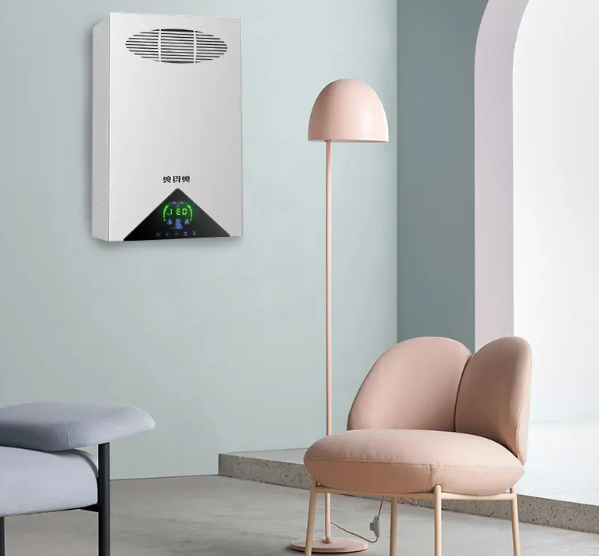
The Fundamental Difference: Recirculation Versus Exchange
An air purifier cleans the air that is already in the room. A ventilation system replaces it. Everything else in this comparison follows from that single distinction.
An air purifier draws indoor air through filter stages and returns it to the same space. Particle and gas concentrations fall, but the composition of the room air does not change in any other respect. Oxygen content stays the same. Carbon dioxide keeps accumulating as occupants exhale. Humidity is untouched. This is why the EPA framework for improving indoor air quality treats ventilation and air cleaning as separate, complementary strategies rather than substitutes.
A ventilation system exhausts indoor air and introduces outdoor air, either through ductwork or a through-wall unit. CO2 falls, oxygen is replenished, humidity can be managed, and indoor-generated pollutants are diluted. What it does not do is deeply filter the air already in the room — the outdoor air intake carries only a basic filter stage in most designs.
Put simply: a purifier is a filter for the air you have; a ventilation unit is a supply of air you do not have. Neither is a substitute for the other, and a sealed room with an excellent purifier will still accumulate CO2 until someone opens a window or a ventilator runs.
Side-by-Side Comparison
|
Dimension |
Air Purifier |
Ventilation System |
Difference |
| Core function | Filters recirculated indoor air | Exchanges indoor and outdoor air | Fundamental |
| Solves particles | Yes — HEPA captures PM2.5 | Partially — intake filter only | Purifier |
| Solves gases / VOCs | Yes — carbon and catalyst stages | Partially — dilution, light filtration | Purifier |
| Reduces CO2 | No | Yes — core function | Ventilation |
| Replenishes oxygen | No | Yes | Ventilation |
| Controls humidity | No | Yes — with ERV core | Ventilation |
| Sizing metric | CADR (m³/h or CFM) | Airflow rate per room volume / ASHRAE 62.2 | Different |
| Test standards | EN 1822, ISO 16890, AHAM CADR | EN 13141, ASHRAE 62.2, local building codes | Different |
| Certification path | Electrical safety (CE, UL, ETL, CB) | Electrical safety + building/ventilation compliance | Ventilation is heavier |
| Installation trade | None — plug and play | HVAC contractor, wall or duct work | Ventilation |
| Installation cost | Zero | 30-60% of product cost | Ventilation |
| Typical buyer | Retail consumer, e-commerce | Contractor, developer, facility manager | Different |
| Return / complaint driver | Performance below claimed CADR | Installation defects, condensation, noise | Different |
The Regulatory Split: Why Customs and Tenders Treat Them Differently
This is the section importers most often skip, and it is the one that generates real financial exposure.
• Air purifiers are appliances. They are regulated primarily as electrical products, with an EMC component for the controls. CE (LVD + EMC), UL or ETL listing, CB reports, and KC or PSE depending on market are the usual requirements. Performance claims such as CADR are typically self-declared or voluntarily verified rather than a customs condition.
• Ventilation systems are building products as well as appliances. Alongside electrical safety, they fall under ventilation performance and, in many markets, building code requirements for minimum fresh-air rates. Products may need local performance testing, and installations may require inspection.
• Harmonised standards differ. Purifiers are tested against filter and air-cleaner standards; ventilation units against ventilation-unit standards that measure airflow, pressure, and heat recovery efficiency. A test report for one category does not transfer to the other.
• Tenders enforce the distinction. A school or hospital tender will specify a ventilation rate or a fresh-air requirement that a purifier cannot satisfy, regardless of its CADR. Bidding a purifier against a ventilation specification fails on technical grounds.
• Energy regulations can apply specifically. Heat recovery efficiency and standby power are regulated for ventilation products in several markets, in a way they generally are not for portable purifiers.
The practical implication for an importer is simple: do not assume that a compliant purifier supplier is automatically a compliant ventilation supplier. Ask for the certificate and test report for the specific product category and the specific model, then verify that the model number and manufacturer entity match. This is the same discipline recommended in the EPA guide to air cleaners for consumer protection, applied at the import level.
Sizing: Two Different Metrics That Cannot Be Substituted
The sizing conversation is where technical credibility is won or lost, because the two categories quantify performance in ways that look comparable and are not.
✓ Purifier sizing uses CADR. Clean air delivery rate expresses how much filtered air the unit delivers per hour. Room coverage claims are derived from CADR and an assumed air-change rate. A 300 m³/h CADR unit is a statement about filtration throughput, nothing else.
✓ Ventilation sizing uses fresh-air rate against room volume. The metric is air changes per hour of outdoor air, or a per-person fresh-air rate derived from a standard such as ASHRAE 62.2. A 100 m³/h ventilation unit delivers 100 m³/h of outside air — a completely different quantity from 100 m³/h of recirculated filtered air.
✓ The numbers are not exchangeable. An importer who tells a project buyer that a 300 m³/h purifier equals a 300 m³/h ventilator is making a claim that will fail on commissioning, and it is the kind of claim that ends a distribution relationship.
✓ CO2 is the honest test. If a room has a CO2 problem, only ventilation moves the number. This is the single most useful diagnostic in the category, and it is worth equipping your sales team with a CO2 meter to settle the argument empirically.
✓ Particle count is the other test. If particles are the problem and CO2 is normal, a purifier is the correct answer, and ventilation will do comparatively little for the deepest size fractions.
The EPA material on indoor particulate matter sets out why particle size determines health relevance. For larger rooms and heavier loads, the ducted and ceiling-mounted ventilator options are the relevant specification starting point.
What Each Product Cannot Do
Importers sell more effectively when they can state the limits of a product honestly. Buyers trust a supplier who tells them where the line is, and they return to that supplier for the second category.
• A purifier cannot lower CO2, cannot add oxygen, and cannot remove humidity or odour sources that are generating continuously. In a sealed meeting room with eight people, a HEPA purifier at maximum output will hold particle counts down while CO2 climbs past 2,000 ppm — the occupants will feel drowsy regardless of the air being visibly clean.
• A ventilation system cannot deliver high-efficiency particle removal. Its intake filter is typically a basic grade, because a dense filter would defeat the purpose of low-resistance continuous airflow. A ventilator running in a city with heavy PM2.5 brings in filtered outdoor air, but not HEPA-grade air.
• Neither product fixes a source problem. Off-gassing furniture, damp walls, and unvented cooking are source issues, and source control comes ahead of both ventilation and air cleaning.
• Neither is a substitute for maintenance. A purifier with a saturated filter and a ventilator with a blocked intake both run normally while delivering a fraction of rated performance.
This is the same hierarchy the EPA introduction to indoor air quality describes, and it is worth repeating to buyers who expect a purifier to solve a ventilation problem.
Installation and After-Sales Reality
The support burden of the two categories is not comparable, and importers should price it into the margin before committing volume.
• Purifier support is largely transactional. Most issues resolve with a filter replacement, a reset, or a remote diagnosis. Return rates are predictable and the product can be shipped back to a warehouse.
• Ventilation support is site-based. Complaints about noise, condensation, or insufficient airflow usually require an on-site visit, and the cause is frequently the installation rather than the product. That means building a contractor network before the first container lands.
• Spare parts matter more for ventilation. Wall sleeves, cores, and fixing kits are not interchangeable between models, and a distributor without stock of the right core cannot service an installed base.
• Filter supply applies to both. Purifiers need HEPA and carbon replacements; ventilators need intake filters and occasionally cores. A product line with no available consumable becomes unsellable after the first year.
• Documentation is part of the product for ventilation. Installation manuals, drilling specifications, airflow tables, and commissioning checklists are not optional extras; without them, installation quality collapses and product reputation follows.
Consumable continuity is the quiet failure mode of this category — it is covered in our long-term air purifier supply model. A distributor running both categories therefore needs two support models: a warehouse-and-refund model for purifiers, and a contractor-and-site-visit model for ventilation. Companies that try to serve both from a single e-commerce desk tend to underperform on ventilation. The AIRDOW ventilation range is supplied with full installation documentation and a stocked consumable path for this reason, and the residential purifier line ships as a plug-and-play product designed for remote support.
Regional Demand: Which Product to Import Where
|
Market |
Stronger Demand |
Reason |
| North America | Purifier | Consumer retail maturity, central HVAC tradition |
| Western Europe | Both, ventilation growing | Airtight new-build codes drive ventilation demand |
| China | Both, ventilation strong | Severe PM2.5 plus strict new-build ventilation norms |
| Korea, Japan | Ventilation strong | Compact housing, established fresh-air culture |
| Southeast Asia | Purifier | Haze seasons, price sensitivity, rental market |
| India | Purifier | Air quality crisis, ventilation retrofits less common |
| Middle East | Purifier + ventilation | Dust load plus cooling-driven sealed buildings |
| Institutional / projects | Ventilation | Codes, tenders and fresh-air specifications |
A distributor covering both categories usually ends up running two separate sales motions: purifiers through retail and e-commerce, ventilation through contractors and projects. The AIRDOW commercial air purifier range and the ventilation range are built to be sold side by side in exactly this way, while the home air purifier range covers the residential retail channel.
Stocking Decision Framework
✓ Import purifiers when your channel is retail, e-commerce, or gifting; your market has an air quality crisis narrative; you want plug-and-play products with no installation dependency; and you can support consumable filter sales.
✓ Import ventilation systems when your market has airtight modern construction or cold-climate heating; your buyers are contractors, developers, or facility managers; and you can support installation partners and technical documentation.
✓ Import both when you serve a mixed base. The two product lines share customers far more often than suppliers admit — a purifier buyer with a CO2 problem is a ventilation lead.
✓ Do not import ventilation as a commodity. Without installation support, spare parts, and filter supply for the intake stage, ventilation products generate a support burden that outweighs the margin.
✓ Test the second category with a small shipment. Ventilation sales cycles are longer and buyer education is heavier; validating demand before committing container volume is the lower-risk route.
Six Mistakes Importers Make
• Treating the categories as substitutes in marketing copy. It creates expectations the product cannot meet and it undermines credibility with technical buyers.
• Assuming certification transfers. A CB report for a purifier does not cover a ventilator, even from the same factory.
• Quoting the wrong sizing metric. CADR and fresh-air rate are not interchangeable, and confusing them surfaces at commissioning.
• Underestimating installation dependency. Ventilation products are only as good as their installation, and that requires a contractor relationship the importer must build.
• Forgetting the consumable path. Both categories need replacement filters; a product with no available filter supply becomes an orphaned SKU.
• Ignoring the building envelope. Ventilation economics depend on how airtight the building is — a market full of leaky buildings will not pay for heat recovery.
• Buying both categories from a supplier who only understands one. Ask which product line the factory actually manufactures, not what the catalogue lists.
• Assuming a consumer-grade purifier can serve a project. Project and tender work usually needs higher CADR, documented test data, and 24-hour duty ratings.
On that first point, the AIRDOW product portfolio is a useful reference for how a manufacturer with genuinely separate lines presents them. On the second, the project-grade commercial purifiers are specified differently from the retail range — higher duty ratings, documented test data, and longer service intervals.
Conclusion: Two Products, Two Businesses
1. Purifiers filter the air a room already has; ventilation systems replace it. CO2 and oxygen only move with ventilation, particles and gases are handled far better by purification
2. Certification does not transfer between the categories — ventilation products carry building-code obligations that purifiers do not, and this is the main import risk
3. CADR and fresh-air rate are different metrics and must never be presented as equivalent; a CO2 meter is the fastest way to prove which product a space actually needs
4. Regional demand splits predictably: purifiers dominate consumer retail in North America and Southeast Asia, ventilation strengthens in Europe, China, Korea and Japan, and in project channels everywhere
5. For distributors, carrying both is a legitimate strategy — but it means running two sales motions, two support models, and two certification files, not one
Importing air treatment products and need both categories from one source? See our OEM and ODM manufacturing overview or contact our export team at ada5@airdow.com.
References and Further Reading
US EPA — Improving Indoor Air Quality
US EPA — Guide to Air Cleaners in the Home
US EPA — Indoor Particulate Matter
US EPA — Introduction to Indoor Air Quality
Post time: Nov-12-2026


