
Almost every air purifier listing leads with a number: three-stage filtration, five-stage filtration, seven layers of purification. The implication is that more stages means more performance, and that a buyer comparing a two-stage product against a four-stage product is looking at an upgrade path. That implication is mostly wrong, and in a meaningful number of cases the reverse is true.
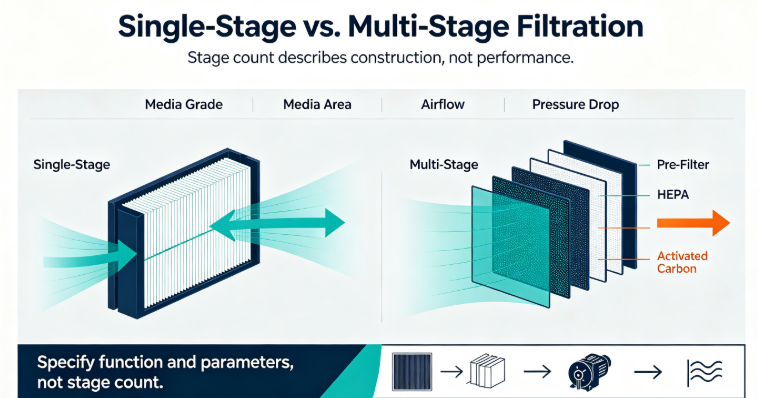
Stage count describes how a product is built, not how well it performs. What actually determines delivered performance is the combination of media quality, total media area, airflow through the unit, and how well the design manages the pressure drop those filters create. A carefully designed two-stage unit can outperform a badly designed five-stage unit on every metric that matters to a customer.
This article breaks down what single-stage and multi-stage filtration actually do, where the genuine performance differences sit, and how buyers sourcing from a factory should specify the configuration rather than accept the stage count on the box.
What a Stage Actually Is — and Why the Count Misleads
A stage is a distinct filtration element in the air path, each performing a specific function. The confusion starts because manufacturers count stages inconsistently: a single filter panel with a pre-filter layer laminated onto it may be marketed as two stages, while a genuinely separate pre-filter, HEPA, and carbon set may also be called three stages. Some brands count an ionizer or a UV lamp as a stage, even though neither is a filter.
Two products advertised as five-stage filtration can therefore differ enormously in physical filter media area, in media grade, and in air resistance. The count tells you how many functions the design attempts. It tells you nothing about how much media is doing the work, which is the variable that governs filter life and capture efficiency.
The practical test is simple: ask for the media area of the HEPA element and the grade it is tested to. A product claiming seven stages with a thin folded HEPA panel has less real filtration capacity than a modest two-stage unit with a deep pleat. The EPA guidance on air cleaners and filters makes the same point in less commercial language: what removes particles is the filter medium, and different media do different jobs.
Single-Stage Filtration: One Job, Done Properly
A single-stage design uses one filtration element — typically a HEPA-grade pleated filter, sometimes with a light carbon layer bonded to the same frame. Its virtue is honesty of purpose: it removes particles, and it does so with the lowest possible resistance in the air path.
• Highest airflow for a given motor and noise budget, because there is only one element to push air through.
• Simplest replacement routine: one part number, one change interval, no sequencing errors.
• Lowest total filter cost in clean environments where the HEPA element is not loading quickly.
• Smallest service footprint, which matters in rental and property-management channels.
• Fewest failure points: no gasket misalignment between stages, no bypass gaps.
The limitation is equally clear. A single HEPA element captures particles but does very little about gases and odours, and without an upstream coarse layer it loads on visible dust and hair, which shortens its life in real homes with pets. In a clean, low-occupancy environment that is a fair trade. In a smoky or heavily occupied room it is not.
Multi-Stage Filtration: Sequencing Different Jobs
A multi-stage design splits the work. Each element is optimised for a task the others cannot do, and the sequence matters as much as the components.
• Stage one, coarse pre-filter: captures hair, lint, and large dust before they reach the fine media. Washable or cheaply replaceable, and it is the single most cost-effective element in the entire product because it protects everything downstream.
• Stage two, HEPA-grade media: the particle workhorse, capturing fine particulate including the fraction that carries the greatest health relevance. This is where the 99.97 percent at 0.3 micron definition applies, and where grade claims should be verified against a named standard.
• Stage three, activated carbon or sorbent media: targets gases, volatile organic compounds, and odours that pass straight through a particle filter. Media mass matters here far more than stage count — a token carbon sheet does almost nothing.
• Optional stages: photocatalysis, UV, ionisation, or cold catalyst elements. These are the stages most often counted for marketing and least often supported by independent performance data. Treat them as optional additions requiring separate evidence.
The second stage is where the terminology gets loose. The HEPA definition of 99.97 percent at 0.3 micron is a technical threshold, and a filter either meets it or does not. Suppliers that describe a filter as HEPA-like, or as 99 percent, should be pressed on which standard they were tested against.
In practice the defensible multi-stage configuration is three functional elements: coarse protection, fine particle capture, and gas and odour control. Beyond that, each additional stage must justify the airflow it costs.
Side-by-Side Comparison
|
Dimension |
Single-Stage |
Multi-Stage |
Advantage |
| Particle capture at equal grade | Equal | Equal | Neutral |
| Gas and odour removal | Minimal | Good to strong | Multi |
| Airflow at equal motor | Highest | Reduced | Single |
| Noise at equal CADR | Lower | Higher | Single |
| Filter change frequency | More often | Less often | Multi |
| Cost per filter change | Lowest | Higher | Single |
| Five-year media cost | Higher in dirty rooms | Lower in dirty rooms | Context |
| Maintenance complexity | Very low | Moderate | Single |
| Number of SKUs to stock | One | Two to three | Single |
| Suitability, clean room | Excellent | Adequate | Single |
| Suitability, urban or smoky | Adequate | Excellent | Multi |
| Suitability, commercial | Adequate | Excellent | Multi |
The Real Performance Difference: Pressure Drop
If there is one technical concept that separates informed buyers from the rest, it is pressure drop. Every filter element resists airflow. Stack three elements and the total resistance rises — and the fan has to overcome it.
The consequence is a genuine design trade-off with three possible resolutions, and every product picks one of them whether or not the designer thought about it.
• Accept lower airflow. The unit moves less air, so clean air delivery rate falls. A multi-stage product with an underpowered fan can end up delivering worse room cleaning than a simple single-stage unit, despite having more filters.
• Fit a larger, more expensive motor. Airflow is restored, but noise rises and energy consumption increases. Good multi-stage designs use high-efficiency brushless DC motors and larger impellers precisely to absorb the added resistance.
• Increase media area. Deep pleats and larger filter face area lower resistance at the same capture efficiency. This is the correct engineering answer, and it is also the expensive one, which is why it is the first thing cut in cost-down versions.
This is why filter grade and stage count alone cannot predict performance. A three-stage unit with deep pleats, a generous carbon bed, and a properly matched motor will beat a five-stage unit built with thin media and a marginal fan. When comparing two products, ask for the clean air delivery rate and the noise level at that rating, then ask how many filter changes per year are expected at that performance level. The answers reveal the design quality that the stage count conceals.
For context on what the purification is protecting against, the EPA overview of indoor particulate matter is a useful reference on why fine particle capture is the primary function and gas removal is a secondary one.
Where Multi-Stage Genuinely Wins
There are clear situations where the additional stages pay for themselves, and buyers should not be talked out of them.
• Environments with meaningful gas load. Cooking, new furniture and finishes, cleaning products, and urban traffic pollution all produce gases that a particle filter cannot remove. In these settings a carbon stage is not a marketing feature; it is the difference between a product that works and one that does not.
• Households with pets or heavy dust. A pre-filter captures the visible load and preserves the HEPA element, which measurably extends its service life and reduces annual cost.
• Smoke exposure, including wildfire seasons and tobacco. Fine smoke particles load HEPA media quickly and odour is significant. Pre-filtration plus carbon is the appropriate configuration.
• Commercial and institutional use. Higher occupancy, longer run hours, and more diverse pollutant sources all justify the full stack, and buyers in these channels usually expect it.
• Markets where filter replacement is inconvenient or expensive. Longer intervals reduce service burden, which has real value in rental and facilities contexts.
For commercial and project supply, the expectation is generally explicit rather than inferred, and the commercial air purifier range is specified around this full-stack logic.
For buyers assembling a full product strategy across segments, the same configuration reasoning applies to the wider catalogue, which can be reviewed from the AIRDOW product overview.
Where Single-Stage Is the Better Buy
The opposite case deserves equal attention, because single-stage products are routinely dismissed as entry-level when they are often the correct specification.
• Clean, low-occupancy spaces. A bedroom in a low-pollution area does not generate enough gas load to justify a carbon bed, and a well-built HEPA unit is the efficient answer.
• Price-sensitive markets. Removing stages removes cost. If the customer’s dominant concern is purchase price and their environment is not challenging, a single-stage product delivers the core benefit without the premium.
• Severe service constraints. Where the customer will not reliably replace multiple filters, fewer parts means fewer failures and fewer complaints.
• Distributors with narrow SKU tolerance. Every additional filter variant is inventory. A one-filter system is dramatically simpler to stock, forecast, and support.
• Applications where airflow matters most. Some rooms need air changes more than they need gas removal, and a low-resistance single-stage unit with high flow is the better engineering choice.
Most residential ranges, including the home air purifier line, are built as modular platforms for exactly this reason: the same chassis can be supplied as single-stage for cost-led markets and as multi-stage for performance-led ones, without redesigning the product.
Buyers weighing which configuration suits a specific market can request a comparison sheet from the export contact desk, including media area, carbon mass, and expected replacement intervals for each variant.
Five-Year Media Cost: The Comparison Buyers Skip
The purchase price difference between the two configurations is small compared with the lifetime media cost difference, and that difference reverses depending on the environment.
|
Scenario |
Single-Stage |
Multi-Stage |
Lower Cost |
| Clean room, low use | 1 HEPA change per 18-24 months | 1 HEPA per 24-36 months + pre-filter | Approximately equal |
| Typical home, some cooking | 1 HEPA per 12 months | 1 HEPA per 18 months + pre-filters | Multi |
| Pets or heavy dust | 1 HEPA per 6-9 months | 1 HEPA per 15 months + pre-filters | Multi, clearly |
| Smoke or high pollution | 1 HEPA per 4-6 months | 1 HEPA per 12 months + carbon | Multi, clearly |
| Commercial, 12h daily | Frequent, high annual cost | Managed intervals, lower annual cost | Multi |
The reason is straightforward: a cheap pre-filter absorbs the load that would otherwise destroy an expensive HEPA element. Buyers who compare only the price of the HEPA filter miss the fact that in dirty environments the single-stage unit consumes several of them per year.
The economics also differ by segment. A residential purifier in a clean suburban home may never recover the cost of a substantial carbon stage, while a commercial installation with long daily run hours recovers it within the first replacement cycle.
How to Read a Stage Claim
A short checklist for evaluating any filtration claim, whether single or multi-stage:
1. Separate functions from filter count. Ask which stages are actual filter media and which are lamps or ionisers.
2. Get the HEPA grade and the test standard. H11, H13, or H14 against EN 1822, or a stated efficiency at a stated particle size.
3. Request the media area of the fine filter. This governs both capture capacity and replacement interval.
4. Request carbon mass in grams. A sorbent stage without stated mass is usually decorative.
5. Confirm the clean air delivery rate at a stated noise level, not just the maximum.
6. Ask for expected filter intervals in a defined dust-loading scenario, not a best case.
7. Check whether the pre-filter is washable and separately replaceable. If it is not, the HEPA element is doing two jobs.
8. Verify the certificate covers the exact model and manufacturer entity.
One more caution applies to the optional stages. Ionisation and ozone-generating technologies are regulated in several markets and are not equivalent to filtration. The EPA position on ozone generators sold as air cleaners is unambiguous, and any product using these technologies as a stage should be assessed separately rather than counted alongside filter media.
What This Means for Buyers Sourcing from a Factory
Stage count is a specification decision, and the advantage of buying from a manufacturer rather than a brand is that the decision belongs to you rather than being fixed by someone else’s product architecture.
• Specify the configuration per market: single-stage for cost-led channels, multi-stage for performance-led ones, on the same platform.
• Specify media area and carbon mass, not stage count. Written specifications prevent the substitution of thinner media in later production runs.
• Specify the motor and impeller to match the chosen filter stack, so that added stages do not silently cost airflow.
• Specify filter part numbers and intervals so the consumable business is defined from the start rather than negotiated later.
• Ask for performance data on the exact configuration you ordered, because the same chassis will produce different numbers with different filter stacks.
That level of specification control is the practical difference between buying a product and commissioning one, and it is what the AIRDOW OEM and ODM model is structured around. For buyers adding a full air strategy, the same logic extends to ventilation and fresh-air systems and to car air purifiers, where cabin volume and duty cycle change the optimal configuration again.
The broader commercial point is covered in our notes on long-term purifier supply relationships: the supplier who will still be quoting the same filter part number in three years is worth more than the one offering the longest stage list today.
Conclusion: Specify Function, Not Stage Count
1. Stage count describes construction, not performance; media grade, media area, airflow, and pressure drop management determine the result
2. Single-stage units deliver the highest airflow and lowest maintenance complexity, and are the correct specification for clean, low-occupancy, cost-sensitive applications
3. Multi-stage units win on gas and odour control, filter longevity in dirty environments, and commercial suitability, where a pre-filter protects an expensive HEPA element
4. Adding stages costs airflow unless media area or motor capability is increased, so a badly designed multi-stage product can underperform a simple one
5. Buyers should specify media area, carbon mass, grade, and replacement intervals in writing rather than accepting a stage count on the packaging
If you are comparing configurations for an upcoming program, send the room size, occupancy, and target market to ada5@airdow.com and the engineering team will return a recommended filter stack with expected replacement intervals for each option.
Need help specifying the right filter configuration for your market? Talk to our engineering team at AIRDOW — ada5@airdow.com — or review our manufacturing and R&D capability and contact the export desk.
References and Further Reading
US EPA — Air Cleaners and Air Filters in the Home
US EPA — What is a HEPA filter?
US EPA — Guide to Air Cleaners in the Home
US EPA — Ozone Generators that are Sold as Air Cleaners
US EPA — Indoor Particulate Matter
US EPA — Improving Indoor Air Quality
Post time: Nov-23-2026


