
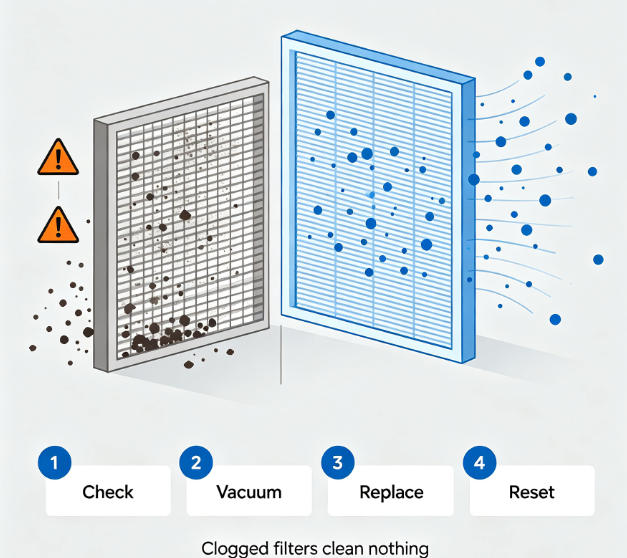
An air purifier with a clogged filter cleans nothing — it just makes noise.
Filter replacement is the single most important maintenance task for any air purifier, yet it is also the most neglected. A HEPA filter past its lifespan not only stops capturing particles efficiently — it can become a breeding ground for bacteria and mold, turning the purifier into a pollution source. Understanding filter lifespan, recognizing replacement indicators, and following proper maintenance procedures keeps your purifier performing at specification.
This guide covers how long HEPA and carbon filters actually last, the factors that accelerate or extend their life, the warning signs of a spent filter, and best practices for replacement.
How Long Do Air Purifier Filters Last?
The typical lifespan ranges below assume standard residential use (8-12 hours per day) in moderately polluted indoor air:
|
Filter Type |
Typical Lifespan |
Key Factor |
Cost (typical) |
| Pre-filter | 6-12 months (washable: 2-3 years) | Dust load; washable versions reuse | $5-15 |
| HEPA H13/H14 | 6-18 months | Usage hours, particle load | $20-60 |
| Activated Carbon | 3-6 months (heavy use) | Gas/VOC load, humidity | $15-40 |
| Combined HEPA+carbon | 6-12 months | Compromise between both | $25-70 |
| Cold catalyst module | 3-5 years | Surface contamination | $30-80 |
| UV-C lamp | 8,000-12,000 hours (1-1.5 yr) | Operating hours | $10-25 |
Factors That Shorten (or Extend) Filter Life
Filter lifespan is not a fixed number — it depends heavily on operating conditions:
• Usage hours — A purifier running 24/7 at high speed processes 3x more air than one running 8 hours at low speed. Filter life scales inversely with total air volume processed.
• Air quality — Homes with smokers, pets, or wood-burning stoves load filters 2-3x faster than clean-air households. Construction/renovation dust is particularly harsh on HEPA.
• Pre-filter effectiveness — A well-maintained washable pre-filter captures large particles before they reach the HEPA, extending HEPA life by up to 3x. This is the cheapest filter-life extension available.
• Humidity — High humidity causes carbon filters to adsorb water vapor, reducing their gas capacity. It also accelerates biological growth on loaded filters.
• Fan speed habits — Running at high speed constantly (e.g., in auto mode with aggressive thresholds) consumes filter life faster than needed for typical conditions.
Signs Your Filter Needs Replacement
Modern purifiers provide electronic indicators, but these can be inaccurate. Learn to recognize the physical signs:
✓ Electronic indicator — Timer-based indicators (counting run hours) are the most common. Smart purifiers with sensors may estimate remaining life from air quality data. Both are approximations — treat them as guidance, not gospel.
✓ Visible discoloration — A HEPA filter that has turned uniformly gray or dark has reached end of life. Patchy discoloration may indicate localized contamination.
✓ Reduced airflow — If you notice weaker air output from the vent at the same fan speed, the filter is clogged and airflow resistance has risen significantly.
✓ Rising noise level — The fan works harder against a clogged filter, producing higher-pitched or louder operation.
✓ Returning odors — If odors that the purifier previously removed start coming back, the carbon filter is saturated and needs replacement.
✓ Higher PM readings — With a PM2.5 sensor-equipped purifier, if room readings rise despite the unit running, filter efficiency has degraded.
How to Replace Air Purifier Filters — Step by Step
Proper replacement procedure ensures the new filter works at full efficiency:
1. Turn off and unplug the purifier before opening any filter compartment.
2. Remove the old filter. Inspect it — if it is heavily loaded, this is a signal to check your pre-filter maintenance routine.
3. Vacuum the filter compartment interior to remove loose dust that could bypass the new filter.
4. Remove the new filter from its packaging. Some filters are individually sealed — remove all plastic wrapping before installation.
5. Check the new filter’s orientation: airflow direction arrows on the filter frame must point in the direction of airflow (usually toward the fan).
6. Insert the filter firmly, ensuring it seats fully in its slot. A poorly seated filter allows unfiltered air bypass.
7. Reset the filter replacement indicator (per your model’s manual — usually a button or app setting).
8. Run the purifier on high speed for 10-15 minutes to seat the filter and confirm normal airflow and noise.
Maintenance Tips to Extend Filter Life
✓ Wash the pre-filter every 2-4 weeks (or vacuum it weekly in dusty environments). This single habit extends HEPA life by months.
✓ Vacuum the exterior vents and intake grilles monthly to maintain unrestricted airflow.
✓ Keep the purifier away from sources of concentrated pollution (kitchen cooking areas, smoking spots) if possible.
✓ In humid climates, run the purifier regularly even when air seems clean — idle filters in humid environments grow mold.
✓ Buy replacement filters only from the manufacturer or certified suppliers. Third-party knockoffs often have inferior media and higher pressure drop.
The B2B Angle: Filter Revenue and Product Design
For B2B buyers, filter replacement is not just a maintenance topic — it is a business model:
• Recurring revenue — Filter sales generate 2-3x the lifetime profit of the initial unit. Products with proprietary filter designs lock customers into your consumables.
• Filter cost transparency — End users increasingly compare total cost of ownership. Products with expensive or short-lived filters lose to competitors with lower annual filter costs.
• Design for serviceability — Tool-free filter access, clear replacement indicators, and QR-code filter reorder links significantly improve customer satisfaction and filter compliance rates.
• Filter subscription models — Some brands offer filter subscription services (e.g., every 6 months), converting one-time buyers into recurring revenue relationships.
Conclusion: Filter Maintenance Is Performance
Filter replacement is not an optional cost — it is the difference between a purifier that performs to specification and one that quietly fails. The key takeaways:
1. HEPA filters typically last 6-18 months, carbon filters 3-6 months in heavy use — but actual lifespan depends on usage hours, air quality, and pre-filter maintenance
2. Learn the physical replacement indicators (discoloration, airflow drop, noise, returning odors) in addition to electronic timers
3. Proper replacement procedure — unplug, clean the compartment, remove all packaging, check airflow direction, reset the indicator
4. Pre-filter washing every 2-4 weeks is the single highest-ROI maintenance habit, extending HEPA life up to 3x
5. For B2B buyers, filter design and pricing are core business decisions — they drive recurring revenue and total cost of ownership perception
Looking for OEM air purifiers with long-life filters and smart replacement indicators? Contact us at ada5@airdow.com for filter specifications, replacement cost analysis, and product design consultation
Post time: Aug-25-2026


