
Author: Locke
Senior Sales Representative — Southeast Asia, South Asia & Japan Markets
Locke has 4+ years of B2B air purifier export experience, having guided importers and distributors across 15+ countries through the China factory sourcing lifecycle — from supplier identification and factory audits to production negotiation and logistics coordination. His hands-on experience at Canton Fair and Hong Kong Electronics Fair, combined with deep factory-floor knowledge, makes him uniquely qualified to help B2B buyers navigate China’s vast air purifier manufacturing landscape.
Connect with Locke on LinkedIn (https://www.linkedin.com/company/airdow/ )or email: ada1@airdow.com for sourcing inquiries.
Introduction: Why Sourcing Air Purifiers from China Remains the Smartest B2B Decision
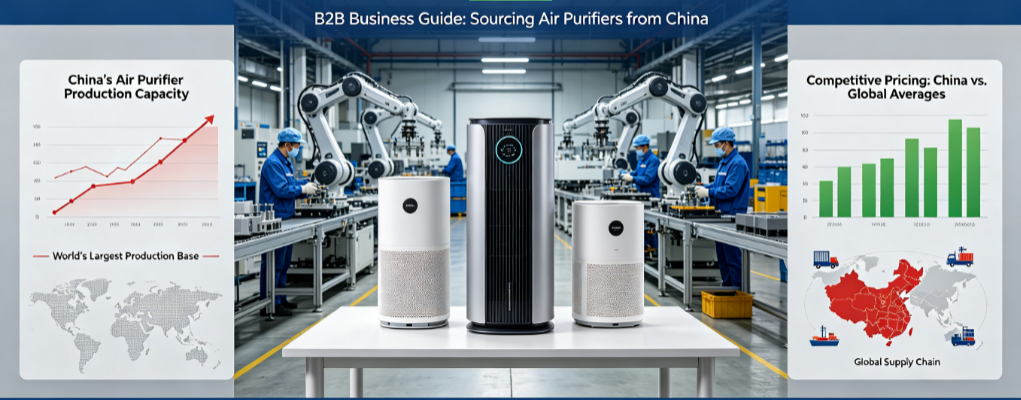
China produces over 70% of the world’s air purifiers. The Pearl River Delta and Fujian province alone host more than 500 air purifier manufacturing facilities, ranging from small component assembly workshops to fully integrated factories with in-house injection molding, filter production, PCB assembly, and R&D centers.
For B2B buyers — importers, distributors, and brand owners — the math is compelling: Chinese factory-direct pricing typically runs 40-65% below comparable European or North American manufactured units of equivalent specification. Add China’s mature component supply chain, massive production capacity, and improving quality management systems, and the question is not whether to source from China, but how to source intelligently.
This guide provides an end-to-end framework for sourcing air purifiers from Chinese factories — covering supplier identification, factory verification, negotiation strategy, quality control, logistics, and post-shipment support. Whether you are placing your first container order or optimizing an existing supply chain, this is your playbook.
1. Supplier Identification: Where to Find Reliable Air Purifier Manufacturers
The first step — finding credible suppliers — is where many B2B buyers lose months chasing dead ends. Here is a tiered sourcing strategy ranked by efficiency:
Tier 1: Industry Trade Shows (Highest Quality Leads)
Canton Fair (Guangzhou, April & October) and Hong Kong Electronics Fair (April & October) remain the gold standard for air purifier supplier discovery. At these events, you can inspect products physically, meet factory decision-makers face-to-face, and gauge a supplier’s professionalism within 30 minutes — something that takes weeks of email correspondence remotely.
- • Canton Fair Phase 1: Electronics & Household Electrical Appliances hall — where most air purifier manufacturers exhibit.
- • HK Electronics Fair: Higher concentration of export-focused, internationally certified manufacturers.
- • Pro tip: Schedule factory visits during the week after the fair. Suppliers are more receptive to hosting buyers who have already visited their booth.
Tier 2: B2B Platforms (Breadth, Requires Filtering)
Alibaba.com and Made-in-China.com host thousands of air purifier supplier listings. However, the platform verification tiers matter enormously:
- • Verified Supplier + Trade Assurance: Minimum baseline. Filters out the most obvious fraudulent listings.
- • Gold Supplier (3+ years): Indicates sustained platform investment. Prioritize these.
- • Assessed Supplier: Third-party onsite verification has been conducted. Request the assessment report.
- • Red flags on B2B platforms: extremely low MOQs for complex products, stock photos only, vague factory address, unwillingness to video call from the factory floor.
Tier 3: Industry Referrals and Trade Associations (Slow but High Trust)
Connect with other importers in your target market through LinkedIn groups, industry associations (like the China Household Electrical Appliances Association), and freight forwarders who specialize in electronics. A forwarder who regularly handles air purifier shipments can often recommend factories they’ve seen deliver consistently.
2. Factory Verification: The Due Diligence Framework
Identifying a supplier is step one. Verifying that the supplier is actually a manufacturer — not a trading company posing as one — is where real due diligence begins.
Here is a 7-point factory verification framework to apply before entering serious negotiations:
|
# |
Verification Point |
What to Check |
|
1 |
Business License | Request the unified social credit code business license. Verify on the National Enterprise Credit Information Publicity System (gsxt.gov.cn). Confirm registration date (pre-2015 = established), registered capital, and business scope explicitly includes ‘air purifier manufacturing’. |
|
2 |
Factory Video Call | Request a real-time video walkthrough of the production floor — not a pre-recorded video. Look for: injection molding machines running, HEPA filter pleating equipment, assembly lines with workers, certification plaques on walls, and air purifier models in various stages of production. |
|
3 |
Export Records | Ask for Bills of Lading from recent air purifier shipments. A legitimate manufacturer should be able to provide redacted BLs showing their name as shipper. Cross-reference with import records on platforms like ImportGenius or Panjiva. |
|
4 |
Certification Portfolio | Verify that certifications (UL, CE, CB, FCC, RoHS) are: (a) in the manufacturer’s name (not a trading company’s), (b) currently valid (check expiry dates), and (c) issued by accredited bodies. A factory that holds certifications in its own name has invested significantly in compliance infrastructure. |
|
5 |
R&D Capability | Does the factory have an in-house design team? Ask to see: product design files, mold drawings, testing reports from their internal lab, any patents they hold. A factory that can show you their patent certificates is a factory that innovates — not just copies. |
|
6 |
Production Capacity | What is the annual output? How many production lines? What shifts do they run? A factory producing 700,000+ units per year with multiple parallel assembly lines can absorb your order without delaying other customers. |
|
7 |
Client References | Request contact information for 2-3 existing B2B clients in markets similar to yours. Call or email them. Ask: delivery reliability, quality consistency, communication responsiveness, and how disputes were handled. |
Red flag: A supplier who refuses a video call, cannot provide a business license, or whose certifications are all in a trading company’s name. These are not necessarily fraudulent — but they are likely trading companies, not manufacturers. Trading companies add a margin layer and reduce your control over production quality and timelines.
3. The RFQ and Negotiation Phase
A well-structured Request for Quotation (RFQ) separates professional buyers from amateurs and immediately signals to the factory that you are serious. Here is what your air purifier RFQ should include:
- • Model specification: Target CADR range, filter type (H13 HEPA preferred), housing material, color preferences, voltage/frequency, plug type for your market.
- • Certification requirements: List every certification your target market requires (CE for EU, UL for USA, KC for Korea, BIS for India, etc.). This directly impacts unit cost.
- • Packaging specification: Retail packaging with your branding, or bulk neutral packaging? Include artwork requirements if OEM.
- • Order volume and frequency: Initial order quantity + estimated annual volume. This gives the factory visibility for production planning and incentivizes better pricing.
- • Target FOB price range: Indicate your budget range. This saves both parties time — if your target is 60% below the factory’s cost floor, you learn that in hours, not weeks.
- • Delivery timeline: Required ex-factory date and preferred shipping method (FCL/LCL/air freight).
Negotiation Strategy
Chinese air purifier factory pricing follows a tiered structure. Understanding this structure empowers your negotiation:
- • Sample order (1-10 units): Usually charged at 1.5-2x the bulk unit price. Expect to pay for samples and shipping.
- • Trial order (100-500 units): Typically at the MOQ tier. Margins are thin for the factory; pricing is moderately negotiable.
- • Standard order (500-2,000 units): 5-10% discount from MOQ pricing is achievable with competitive bidding.
- • Bulk order (2,000+ units): 10-15% discount. At this volume, you should request a dedicated production line allocation and priority scheduling.
- • OEM contract (annual commitment): 15-25% discount potential. Negotiate quarterly pricing reviews tied to raw material index to protect both parties from cost fluctuation.
The most effective negotiation tactic: bring quotes from 2-3 verified competing factories. Chinese manufacturers understand competitive pressure and will sharpen their pencil when they know you have alternatives. But never fabricate competing quotes — factory owners talk to each other, and a reputation for dishonesty follows you.
4. Production, Quality Control, and Pre-Shipment Inspection
The period between purchase order confirmation and container loading is where value is either preserved or destroyed. A robust quality control plan has three checkpoints:
Checkpoint 1: Pre-Production Inspection (PPI)
Before production begins, verify: raw materials (filter media grade, ABS resin batch, electronic components) match the approved specification. The most common quality variance — substitution of H13 filter media with H11 — happens at this stage. Your inspector should pull material certificates and cross-check filter media supplier names.
Checkpoint 2: During-Production Inspection (DPI)
At 30-50% production completion, inspect: assembly quality on the first finished units, filter-to-housing seal integrity, fan balance and noise level, control panel functionality, and packaging quality. Catching an assembly issue at 30% completion allows corrective action before the entire batch is affected.
Checkpoint 3: Pre-Shipment Inspection (PSI)
When 100% of goods are produced and at least 80% are packed, conduct a final random sampling inspection using AQL (Acceptable Quality Level) standards. For air purifiers, we recommend:
- • AQL 2.5 for visual/cosmetic defects (Level II sampling).
- • AQL 1.0 for functional defects (power-on, fan operation, filter fit, sensor response).
- • AQL 0.65 for safety-critical items (power cord integrity, grounding, leakage current).
- • Special inspection: Run 5% of sampled units for 4+ hours continuously. Fan motors that fail in the first 4 hours indicate a bad batch.
Should you hire a third-party inspection company? For first orders from a new supplier: absolutely. Companies like SGS, Intertek, Bureau Veritas, and AsiaInspection offer air purifier-specific inspection protocols for $300-500 per man-day in China. This is the cheapest insurance policy in your supply chain.
5. Shipping, Logistics, and Import Documentation
With goods produced and inspected, the final phase is getting them to your warehouse. Here is the logistics decision framework for air purifier imports:
|
Shipping Mode |
Best For |
Transit Time |
Considerations |
| FCL Sea (20ft/40ft) | Orders 500+ units | 20-40 days | Lowest cost per unit. Requires full container planning. |
| LCL Sea | Orders 50-400 units | 25-45 days | Higher per-unit cost. Consolidation delays at transshipment ports. |
| Air Freight | Urgent orders, samples | 5-10 days | 10-15x sea freight cost. Justifiable for time-sensitive commercial launches. |
| Rail (China-Europe) | EU-bound mid-volume | 18-25 days | Faster than sea, cheaper than air. Growing option for EU importers. |
Essential shipping documents you need from the factory:
- • Commercial Invoice — FOB value breakdown, HS code, country of origin, payment terms.
- • Packing List — carton-level detail: dimensions, weight, quantity per carton, total pieces.
- • Bill of Lading (sea) or Air Waybill (air) — consignee and notify party must match your customs broker’s instructions exactly.
- • Certificate of Origin — Form E (ASEAN-China FTA) or Form A (GSP) for preferential duty rates where applicable.
- • Fumigation Certificate — required for solid wood packaging (not required for plywood/paper/honeycomb pallets).
- • Insurance Certificate — CIF buyers should ensure the factory provides a policy covering 110% of invoice value.
Pro tip: Engage a customs broker in your destination country before the goods ship. Provide them the full documentation package while goods are in transit so they can pre-file and clear customs on arrival day — saving demurrage and storage charges.
6. Why AirDow Is Structured to Deliver for B2B Importers
ADA Electrotech (Xiamen) Co., Ltd. — operating internationally as AirDow — was founded in 1997 and has been manufacturing air purifiers continuously for 27+ years. Our operational structure is specifically designed to reduce the friction points B2B importers encounter when sourcing from China:
- • Vertical integration: 20,000+ sqm facility housing injection molding, filter production, PCB assembly, painting, and final assembly — all under one roof. No subcontractor dependency.
- • Annual output exceeding 700,000 units across 5+ parallel assembly lines — we can absorb your order without disrupting other clients.
- • Pre-certified across markets: UL (USA), CE (EU), CB (international), FCC, KC (Korea), PSE (Japan), GS (Germany), RoHS, and ISO 9001:2015. Your market’s certification likely already exists in our portfolio.
- • OEM/ODM maturity: 60+ design patents, 25+ utility patents, and a dedicated OEM project management team that handles your custom design from concept to container.
- • Transparent communication: you deal directly with factory sales engineers, not intermediaries. Factory video tours, production status photos, and real-time shipment tracking are standard — not special requests.
- • Client portfolio: long-term OEM partnerships with brands including HAIER, Audi, Home Depot, Electrolux, and other globally recognized names — third-party validation of our manufacturing quality.
Starting your air purifier sourcing journey? Contact Locke at ada5@airdow.com for a same-day response with preliminary pricing, certification documentation, and factory introduction materials.
Frequently Asked Questions About Sourcing Air Purifiers from China
Q: What is the typical MOQ for OEM air purifiers from Chinese factories?
Standard MOQ for OEM air purifiers ranges from 300-500 units per model for established manufacturers. Some factories offer lower MOQs (100-200) but at significantly higher per-unit pricing that erodes your margin. At AirDow, our standard MOQ is 500 units per model for OEM orders, with flexibility for trial orders of 100-200 units at a marginal premium. MOQ varies by model complexity — custom housing designs requiring new injection molds typically require 1,000+ units to amortize mold investment.
Q: How do I verify that a Chinese air purifier factory is legitimate?
Five verification layers: (1) Business license check on gsxt.gov.cn, (2) real-time factory video tour — not pre-recorded, (3) export records via ImportGenius or similar databases, (4) certification verification directly on certifying body websites (UL, Intertek, TÜV all have online certificate lookup), (5) client reference calls. A legitimate factory will pass all five. A trading company will fail at step 2 or 3.
Q: What payment terms are standard for air purifier orders from China?
Industry standard for first orders: 30% deposit with purchase order, 70% balance before shipment (T/T). For established relationships: 30% deposit, 70% against copy of Bill of Lading. Letter of Credit (L/C) at sight is available for orders above $50,000 but adds 1-3% to the transaction cost. Open account terms (Net 30/60) are rare for first-time B2B buyers from Chinese factories and typically require a multi-order history.
Q: How long does a typical OEM air purifier order take from PO to delivery?
Standard timeline: 35-45 days production + 20-40 days sea freight = 8-12 weeks total. Add 4-6 weeks if new injection molds are required. Rush production (25-30 days) is sometimes possible with a 5-10% surcharge. Air freight reduces transit to 5-10 days for urgent commercial launches but increases logistics cost 10-15x.
Conclusion: China Sourcing Is a Skill — Develop It Systematically
Sourcing air purifiers from China is not a one-time transaction — it is a capability that, when developed systematically, becomes a durable competitive advantage. The frameworks in this guide — supplier identification, factory verification, structured RFQ, three-checkpoint QC, and logistics planning — are repeatable processes that compound in value with every order.
The B2B buyers who succeed are not the ones who find the cheapest quote on Alibaba. They are the ones who build relationships with verified manufacturers, invest in quality assurance, and treat their supply chain as a strategic asset rather than a cost center.
Ready to start your China air purifier sourcing journey with a verified, certified, and experienced manufacturing partner? Contact Locke at ada11@airdow.com . We respond to qualified B2B inquiries within 24 hours with preliminary pricing, certification documentation, and a factory introduction.
Post time: Jun-23-2026


