
One system lives on your ceiling and never touches your floor. The other sits in the corner of the room. Both clean air — but they solve different problems in different spaces.
The choice between a ceiling-mounted ventilation system and a floor-standing air purifier is one of the most common decisions facing buyers, facility managers, and product line managers. The two categories differ on nearly every practical dimension: where they sit, how they distribute air, how much floor space they consume, what they cost to install, and how well they scale across a building.
This guide compares ceiling ventilators and floor purifiers across space requirements, coverage area, installation complexity, maintenance, and cost — and explains which system fits which environment.
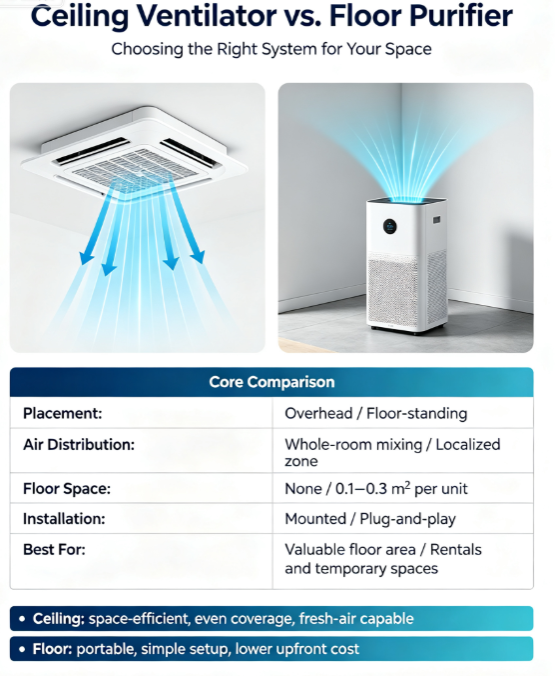
The Fundamental Difference: Placement Determines Performance
• Ceiling ventilator — Installed overhead, usually recessed or surface-mounted. Draws air from the room, filters it (and in ventilation models, exchanges it with outdoor air), then distributes clean air downward over a wide area. No floor footprint at all.
• Floor purifier — Portable unit standing on the floor, drawing air in from the base or sides and discharging through the top. Recirculates room air in a defined cleaning zone. Can be moved between rooms at will.
• Why placement matters — Air distribution, not just filtration efficiency, determines real-world effectiveness. A ceiling unit uses downward displacement and room-wide mixing; a floor unit creates a localized clean-air zone that is strongest near the unit.
Ceiling Ventilator vs. Floor Purifier: Full Comparison
|
Dimension |
Ceiling Ventilator |
Floor Purifier |
Advantage |
| Floor space | None (overhead) | 0.1-0.3 m² per unit | Ceiling |
| Installation | Ceiling mount, often ducted/vented | Plug-and-play | Floor |
| Coverage | Whole room, even distribution | Localized, strongest near unit | Ceiling |
| Air changes (ACH) | Higher (downward mixing) | Moderate (recirculation zone) | Ceiling |
| Fresh air capability | Yes (vented models) | No (recirculation only) | Ceiling |
| Portability | Fixed location | Fully portable | Floor |
| Noise source height | Above head, farther from ears | Ear level if placed low | Ceiling |
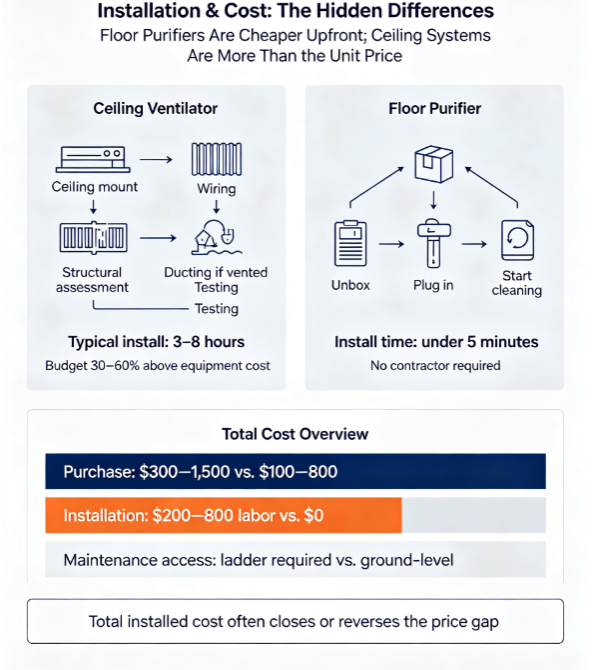
| Purchase cost | $300-1,500 per unit | $100-800 per unit | Floor |
| Install cost | $200-800 labor + wiring | $0 | Floor |
| Maintenance access | Ladder required | Ground-level, easy | Floor |
| Rental/lease friendly | No (structural work) | Yes | Floor |
| Scalability | Excellent for large rooms/halls | Good for individual rooms | Ceiling |
Space Requirements: Floor Footprint vs. Ceiling Structure
The trade-off is simple: a ceiling unit consumes vertical space and structure, a floor unit consumes horizontal space and furniture layout freedom.
• Ceiling unit needs — Ceiling void depth (75-250mm for recessed units), structural fixing points rated for the unit weight (5-25 kg), and power routing to the ceiling. Vented models also need a duct path to an exterior wall or roof.
• Floor purifier needs — Clear floor area of roughly 0.1-0.3 m² per unit, plus 30-50cm clearance around intakes. In small apartments this is often the constraint: a purifier in every bedroom consumes meaningful living space.
• High-traffic spaces — In retail, restaurants, and lobbies, floor units obstruct cleaning routes, get bumped, and create trip hazards. Ceiling units eliminate these issues entirely.
• Heritage and finished interiors — Where ceiling work is not possible, floor units are the only option. Conversely, in spaces with valuable floor area (showrooms, clinics), the ceiling unit recovers usable space.
Coverage Area: How Each System Distributes Clean Air
Coverage claims on both product types should be treated as best-case numbers. Real distribution depends on the design of the space:
✓ Ceiling distribution — Downward airflow creates a broad, even clean-air field. Works well in open rooms with standard ceiling heights (2.4-3.0m). In rooms higher than 3.5m, clean air may not reach the breathing zone effectively — a common failure in atriums and warehouses.
✓ Floor distribution — Clean air exits upward and returns via the base, creating a vertical circulation loop. Effective within roughly 3-5m of the unit in open conditions. Blocked by furniture, curtains, or walls — placing a purifier in a corner behind a sofa can halve its useful coverage.
✓ CADR comparison — Ceiling units generally achieve higher effective ACH because they are not obstructed and mix the entire room volume. Floor units quote CADR under ideal conditions; real-world performance is typically 20-40% lower in furnished rooms.
✓ Multiple units — For rooms over 40 m², both types usually need multiples. Ceiling units scale more gracefully because they can be zoned per ceiling grid; floor units need more power outlets and floor space.
Installation Complexity: The Deciding Factor for Many Projects
1. Ceiling ventilator — Requires a licensed electrician or HVAC contractor, ceiling access (existing void or new opening), structural fixing assessment, and for vented models an exterior duct route. Typical install time: 3-8 hours per unit. Retrofit in a finished ceiling adds cost and complexity.
2. Floor purifier — Unbox, remove packaging, plug in. Install time: under 5 minutes. No contractor, no permits, no structural assessment. This is the decisive advantage in rental properties, temporary spaces, and fast-turnaround projects.
3. Hidden cost of ceiling installs — Electrical wiring runs, ceiling repair and repainting, and possible sprinkler or fire-detection coordination in commercial buildings. Budget 30-60% above the equipment cost for professional installation.
4. Retrofit reality — In existing buildings without ceiling voids or spare circuits, ceiling units can be impractical. Floor purifiers remain the only deployable option in many older properties.
Cost Analysis: Purchase, Install, and Lifetime
• Upfront — Floor purifiers win on sticker price, typically 50-70% cheaper per unit than ceiling systems of comparable airflow.
• Installed cost — Once labor is included, the gap narrows or reverses. A $400 ceiling unit with $500 installation costs more than a $500 floor purifier with zero installation.
• Operating cost — Both consume similar power for equivalent airflow (20-80W). Ceiling units with DC motors and heat-recovery cores can offset heating/cooling costs, which floor purifiers cannot.
• Maintenance labor — Floor units are serviced from ground level in seconds. Ceiling units require a ladder or lift, increasing maintenance time by 3-5x and creating safety considerations in commercial settings.
• Replacement cycle — Both last 5-10 years. Ceiling units are more expensive to replace because installation costs recur, while floor units are simply swapped.
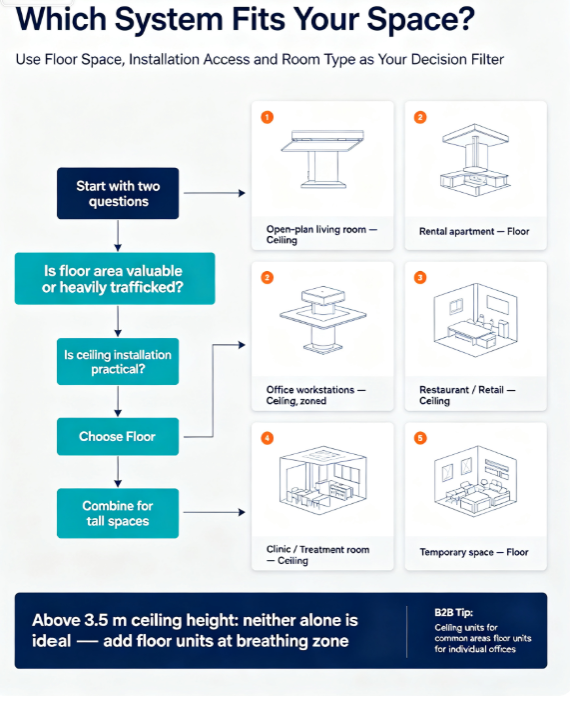
Which System for Which Space? Decision Framework
|
Scenario |
Recommended System |
| Open-plan living room, own property | Ceiling ventilator (even coverage, no floor clutter) |
| Small bedroom, rental apartment | Floor purifier (portable, no installation) |
| Office with multiple workstations | Ceiling ventilators, zoned per grid |
| Restaurant / KTV / retail floor | Ceiling ventilator (floor space is revenue space) |
| Clinic or treatment room | Ceiling (hygienic, nothing on floor to obstruct cleaning) |
| Historic building, no ceiling access | Floor purifiers only |
| Temporary or seasonal space | Floor purifiers (redeployable) |
| Large hall over 3.5m ceiling height | Neither alone — combine with floor units at breathing zone |
| New construction with ventilation design | Ceiling unit with fresh-air exchange |
B2B Perspective: Product Line Strategy
• Different buyers — Floor purifiers sell to consumers, renters, and small offices through retail and e-commerce. Ceiling units sell to contractors, developers, and facility managers through project channels with longer sales cycles.
• Different margins — Ceiling units carry higher unit value and often higher absolute margin, but require technical support, installation documentation, and spec-sheet selling.
• Bundle opportunity — Distributors covering both categories can serve an entire building: ceiling units for common areas, floor units for individual offices.
• Regional demand — Ceiling-mounted ventilation is well established in China, Korea, and Japan; floor purifiers dominate consumer markets in North America and Europe. Emerging markets often start with floor units and graduate to ceiling systems as construction standards tighten.
• Specification selling — Ceiling products win on documentation: airflow curves, sound power data, ceiling load ratings, and installation manuals. Suppliers who provide these close projects faster.
Conclusion: It Depends on the Space, Not the Spec
There is no universally superior system — only the right fit for a given space:
1. Ceiling ventilators win on space efficiency, even coverage, and fresh-air capability; floor purifiers win on portability, installation simplicity, and upfront cost
2. Floor space is the pivotal variable: where floor area is valuable or heavily trafficked, ceiling units pay for themselves; where it is not, floor units are cheaper and faster to deploy
3. Installation complexity is the hidden cost — budget 30-60% above equipment cost for professional ceiling installation, versus zero for plug-and-play floor units
4. Coverage claims need scrutiny: ceiling distribution struggles above 3.5m heights, while floor purifiers lose 20-40% of their CADR in furnished rooms
5. For B2B suppliers, carrying both categories enables complete building solutions and access to both retail and project channels
Evaluating ceiling ventilation or floor purifier product lines for your market? Contact us at ada5@airdow.com for product specifications, comparison data, and OEM program details.
Post time: Sep-23-2026


