
A wall-mounted ventilator is the fastest route to fresh air in a home that was never designed for ductwork.
Unlike ducted whole-house systems that require planning during construction, a wall-mounted ventilator installs through a single exterior wall in a matter of hours. It brings filtered outdoor air in, exhausts stale indoor air out, and recovers energy in the process — all without a single meter of ducting. For apartments, retrofits, and rental units, it is often the only practical ventilation solution available.
But wall-mounted units vary enormously in real-world performance. Two products with the same claimed airflow can differ by 10 dB in noise or double in filter pressure drop. This guide covers the specifications that actually matter — airflow capacity, noise levels, filtration grades, energy recovery — plus practical installation tips for both OEM buyers and installers.
What Is a Wall-Mounted Ventilator?
A wall-mounted ventilator (also called a wall-mounted fresh air ventilator, through-wall ventilator, or ductless ERV) is a compact ventilation unit installed directly through an exterior wall. It typically provides two-way airflow — supply and exhaust — through a single wall sleeve, with a ceramic or enthalpy core transferring heat between the two air streams.
• Ductless — No distribution ductwork required. Ideal for apartments and finished homes.
• Through-wall sleeve — A 100-200mm core hole carries both air paths through one opening.
• Balanced or single-direction — Two-way models exchange air simultaneously; single-direction models work in alternating cycle mode.
• Room-level coverage — Typically serves one room of 20-40 m², unlike whole-house systems.
Key Specifications You Must Evaluate
These are the specs that determine whether a unit performs in practice — not just on paper:
|
Specification |
Typical Range |
What to Look For |
Priority |
| Airflow capacity | 30-120 m³/h | Match to room volume (0.5-1.0 ACH) | Critical |
| Noise level | 25-45 dB(A) | Under 30 dB at low speed | Critical |
| Filtration grade | G3 pre-filter + H11-H13 HEPA | H13 for allergy/PM2.5 markets | High |
| Heat recovery efficiency | 50-85% | Counter-flow ceramic cores rank highest | High |
| Power consumption | 3-35W | Look for DC motors, not AC | Medium |
| Wall sleeve diameter | 100-200 mm | Larger = more airflow, harder install | Medium |
| Operating modes | 2-3 speeds, boost, night mode | Night mode under 25 dB | Medium |
| Filter replace cost | $8-25 per set | Low-cost filters drive compliance | Medium |
| Control | Remote, wall switch, WiFi | WiFi/Tuya for smart home markets | Optional |
| IP rating | IPX2-IPX4 | Higher for bathrooms/kitchens | Optional |
Airflow Capacity: Sizing to the Room, Not the Spec Sheet
Manufacturers market airflow figures measured at free air — with no filter and no wall sleeve. Real installed airflow is typically 30-50% lower. Always compare units at equivalent filter and sleeve conditions.
• Room sizing rule — Target 0.5-1.0 air changes per hour (ACH). A 30 m² room with 2.7 m ceilings (81 m³) needs 40-80 m³/h of real delivered airflow.
• Occupancy adjustment — Add capacity for people: roughly 30 m³/h per additional occupant beyond two, to keep CO2 below 1,000 ppm.
• Derate the spec — Assume delivered airflow is 60-70% of the catalog number once HEPA filters and the wall sleeve are fitted. Size up accordingly.
• Filter loading over time — Airflow drops as filters load. A unit with minimal headroom will underperform at month six. A variable-speed DC motor compensates by increasing RPM.
Noise Levels: The Spec That Decides Product Success
In bedrooms, noise is the number one complaint and the leading cause of owners simply switching the unit off. For a unit serving a sleeping area, noise matters more than airflow.
✓ Target thresholds — Low speed: under 25-30 dB(A) is acceptable for bedrooms. Medium: under 35 dB(A) for living spaces. High/boost mode: up to 45 dB(A) is tolerable for short periods.
✓ Measurement honesty — Cheap units quote sound pressure at 1 m in free air. Ask for sound power or measurements at typical residential distance (2-3 m). A difference of 3 dB equals roughly double the perceived loudness ratio — do not treat small numbers as trivial.
✓ DC motors over AC — Brushless DC (BLDC) motors run smoother and quieter across the speed range, and typically consume 50-70% less power at low speed.
✓ Installation impact — Poor wall sealing and rigid mounting transmit vibration into the wall structure, amplifying noise. Anti-vibration padding and a sealed sleeve are as important as the unit’s own noise rating.
Filtration Grades: What Actually Arrives in the Room
A ventilator’s job is fresh air, but in polluted urban environments it must also be a filter. Look at two filter stages:
• Pre-filter (G3-G4) — Captures pollen, dust, and large particles. Protects the HEPA stage and should be washable or cheaply replaceable.
• Main filter (H11-H13 HEPA) — The stage that determines particle removal. H13 (99.95% at MPPS) is the standard for allergy and PM2.5-conscious markets; H11 is acceptable for general use but weaker on fine particles.
• Activated carbon layer — Optional but valuable in urban areas for traffic-related gases (NOx, SO2) and odors. Even a thin carbon layer changes the product pitch significantly for city apartments.
• Pressure drop trade-off — Higher filtration grade means more resistance against the fan. A H13 filter on an underpowered unit results in poor delivered airflow. Balance grade against motor capability.
• Filter access — Front-access filter doors that open without tools double the chance owners actually replace filters on schedule.
Heat Recovery: Small Unit, Real Savings
Wall-mounted units typically use one of two core types. Recovery efficiency of 60-80% is achievable in compact counter-flow ceramic cores.
• Ceramic regenerator core — Alternates airflow direction (cycle mode). Heat stored in the ceramic is released back to incoming air. Cheap, compact, highly effective in cold climates, and washable.
• Enthalpy (membrane) core — Transfers both heat and moisture. Better in humid climates where incoming humidity would otherwise raise indoor moisture load.
• Real-world expectation — With 70% recovery, supplying 60 m³/h at -5°C outdoors into a 22°C room raises incoming air to roughly +14°C. The energy saved per winter month on a single unit is modest; across a building of units it is substantial.
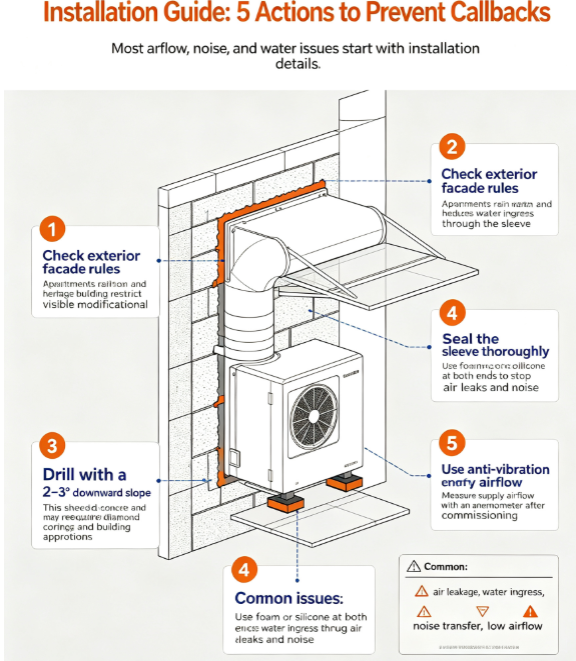
Installation Tips That Prevent Callbacks
1. Confirm wall construction before ordering — Core drilling through reinforced concrete needs a diamond core drill and approval from the building. Stud and brick walls are straightforward; load-bearing or post-tensioned concrete may not be permitted.
2. Check the exterior facade rules — Apartment associations and heritage buildings often restrict visible exterior modifications. Confirm before drilling a 160mm hole.
3. Drill with a 2-3 degree downward slope toward the outside — This sheds rain and prevents water ingress through the sleeve.
4. Seal the sleeve thoroughly — Foam or silicone both ends. A poorly sealed sleeve leaks air around the unit, undermining both efficiency and noise performance.
5. Position for airflow, not convenience — Place the unit near the ceiling where warm, stale air collects, or near the breathing zone if the goal is direct fresh-air delivery. Avoid placing it directly behind curtains or furniture.
6. Space exterior intake and exhaust — For units with separate external ports, keep at least 1 m between them to prevent exhaust short-circuiting back into the intake.
7. Mount on anti-vibration pads — Especially on thin stud walls. This alone can remove several dB of transmitted noise.
8. Verify delivered airflow after installation — Use an anemometer at the supply grille. If measured airflow is far below spec, check filter seating and sleeve obstruction.
9. Label and hand over filter maintenance instructions — Include the filter part number. Units where owners cannot identify the replacement filter get abandoned.
B2B Buying Checklist for Wall-Mounted Ventilators
✓ Demand third-party test data — Airflow at installed condition, sound power level, and heat recovery efficiency from an accredited lab, not just catalog claims.
✓ Check voltage and plug standards per market — EU/US/UK/AU variants and certification (CE, ETL, UKCA, CB) should be confirmed before quoting.
✓ Verify filter availability in writing — A 5-year filter supply commitment with stable part numbers is essential for distributor confidence.
✓ Evaluate maintenance design — Tool-free core removal and front-access filters reduce after-sales support load significantly.
✓ Confirm remote/app options — Tuya-based WiFi control is increasingly expected in smart-home markets and costs little to add at the manufacturing stage.
Conclusion: Specs to Prioritize
Wall-mounted ventilators succeed or fail on a small number of specifications. Prioritize in this order:
1. Real delivered airflow (after filtration and sleeve losses) — justify the unit against 0.5-1.0 ACH for the actual room volume
2. Noise at low speed (under 25-30 dB for bedrooms) — the spec most likely to determine whether the unit is used at all
3. Filtration grade (H13 for allergy markets, plus optional carbon for urban environments)
4. Heat recovery efficiency of 60-80% with a washable or long-life core
5. Installation quality — slope, sealing, anti-vibration mounting, and post-install airflow verification prevent nearly all callbacks
Sourcing wall-mounted ventilators for your market? Contact us at ada5@airdow.com for full technical specifications, certification documentation, and OEM customization options.
Post time: Sep-15-2026


