
An air purifier cleans the air you already have. A fresh air system brings in air you do not have yet. They are not competitors — they are complementary.
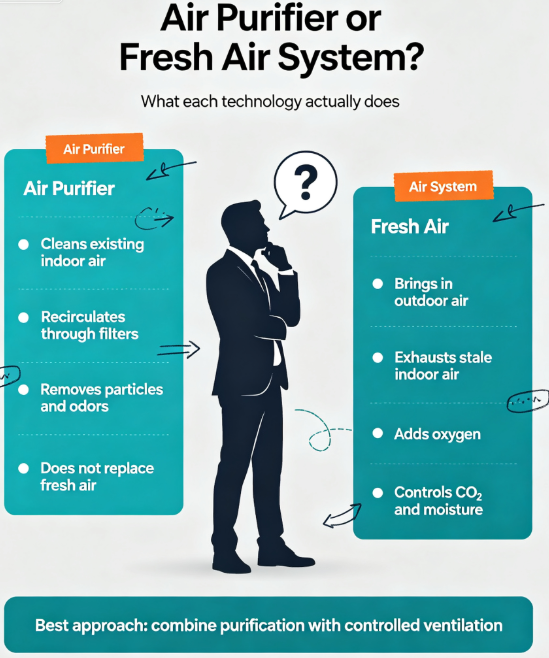
One of the most common misconceptions in indoor air quality is that air purifiers and fresh air ventilation systems do the same job. In reality, they solve fundamentally different problems. An air purifier recirculates and filters indoor air; a fresh air system (also called ventilation system or air exchanger) brings outdoor air in and exhausts stale indoor air. Modern systems — ERV and HRV — do this while recovering heating or cooling energy.
For B2B buyers and distributors, understanding the difference is essential for positioning products correctly and building solution bundles. This guide compares the two technologies across every important dimension.
Core Differences: What Each System Actually Does
The fundamental difference is air source:
• Air purifier — Recirculates indoor air through filters. Removes particles, gases, and odors from the existing indoor air. Does not introduce fresh air. CO2 levels and oxygen content are unchanged.
• Fresh air system — Exchanges indoor and outdoor air. Brings in filtered outdoor air (fresh oxygen) and exhausts stale indoor air containing CO2, moisture, and indoor pollutants. Does not deeply filter recirculated air.
• The overlap — Some fresh air systems include basic filtration (typically MERV 8-13 or HEPA on the intake), and some purifiers include a small fresh-air intake. But neither fully replaces the other.
Fresh Air System vs Air Purifier: Full Comparison
|
Dimension |
Air Purifier |
Fresh Air System (ERV/HRV) |
Winner |
| Primary function | Filter recirculated indoor air | Exchange indoor/outdoor air | Complementary |
| Removes PM2.5/pollen | Excellent (HEPA) | Moderate (intake filter grade) | Purifier |
| Reduces CO2 | No | Yes (core function) | Fresh air |
| Brings in oxygen | No | Yes | Fresh air |
| Controls humidity | No | Yes (with ERV core) | Fresh air |
| Removes formaldehyde/VOCs | Yes (carbon/catalyst) | Partial (dilution + filter) | Purifier |
| Installation | Plug-and-play, portable | Ducted or wall-mount, permanent | Purifier |
| Coverage | Single room (CADR-based) | Whole home/office | Fresh air |
| Cost | $100-800 | $1,000-5,000+ installed | Purifier |
| Energy impact | Low (fan only) | Higher (fan + energy recovery) | Purifier |
| Noise | 30-65 dB | 35-60 dB (ducted units quieter) | Similar |
| Maintenance | Filter changes 2-4x/year | Filter changes + core cleaning | Purifier |
ERV and HRV Explained: Energy Recovery Makes Ventilation Affordable
The objection to ventilation has always been energy loss: exhausting warm indoor air in winter (or cool air in summer) wastes heating/cooling. Energy recovery ventilation solves this:
• HRV (Heat Recovery Ventilator) — Transfers heat between outgoing and incoming air streams. In winter, warm exhaust air pre-heats cold incoming air. Recovers 70-90% of heat energy.
• ERV (Energy Recovery Ventilator) — Transfers both heat AND moisture. In humid climates, it prevents outdoor humidity from entering; in dry climates, it preserves indoor humidity. The better choice for most residential applications.
• How it works — A cross-flow or counter-flow heat exchanger core separates the two air streams. No air mixing occurs — only heat and (for ERV) moisture pass through the membrane.
• Real-world impact — With 80% energy recovery, running a whole-house ERV costs roughly the same as running two small fans continuously, while providing continuous fresh air.
When to Choose Which — Decision Framework
The right choice depends on the problem you are solving:
✓ Choose an air purifier when: The issue is indoor-generated pollution (dust, pollen, smoke, pet dander, cooking odors) and the building already has adequate ventilation. Portable purifiers are ideal for renters and single rooms.
✓ Choose a fresh air system when: CO2 levels are high (crowded rooms, sealed modern buildings), humidity is a problem, or you want whole-home continuous ventilation. Required for airtight new constructions under modern building codes.
✓ Choose both when: The space has both ventilation problems (high CO2, stuffiness) and pollution problems (particles, VOCs). This is the recommended combination for bedrooms, offices, and renovated apartments.
✓ Consider a hybrid: Some wall-mounted fresh air ventilators include HEPA filtration on the intake, providing fresh air with filtered particles — a single-unit compromise for retrofit installations.
Installation and Practical Considerations
• Ducted whole-house ERV/HRV — Requires ductwork planning, best installed during construction or major renovation. Professional installation is essential. Central unit cost $1,000-3,000 plus ducting.
• Wall-mounted ventilators — Single-room or small-apartment units installed through an exterior wall. No ductwork needed. Typical cost $300-800. Popular in Chinese and Japanese retrofit markets.
• Window/through-wall fresh air purifiers — Lower-cost units that combine a fresh air intake with HEPA filtration, designed for apartments. Effective for single rooms.
• Air purifier with fresh air mode — Some premium purifiers include a small fresh-air intake (e.g., 30-60 m³/h). Useful for light ventilation supplement but not a replacement for a real ventilation system.
The B2B Opportunity: Bundling and Positioning
• Growing demand — Post-COVID awareness of CO2 and indoor air quality, plus airtight modern construction, is driving fresh air system demand in residential and office segments.
• Product line synergy — Distributors offering both purifiers and fresh air systems can sell solution bundles: purifier for the bedroom, wall-mounted ventilator for the living room.
• Market differences — China and Korea lead in wall-mounted ventilators; Europe and North America favor ducted ERV/HRV for new construction; Southeast Asia is an emerging market for both.
• Margin profile — Fresh air systems carry higher price points ($300-3,000) and higher margins than portable purifiers, but require more after-sales support and installation partnerships.
Conclusion: They Solve Different Problems
The air purifier vs fresh air system debate is a false choice. They address different dimensions of indoor air quality — filtration of existing air versus renewal of stale air. The best solution for most spaces is both, deployed according to the specific problems present.
1. Air purifiers filter particles and gases from recirculated air; fresh air systems reduce CO2, add oxygen, and control humidity — they are complementary, not competing
2. ERV/HRV energy recovery (70-90%) makes continuous ventilation affordable, addressing the main historical objection of energy loss
3. Choose based on the problem: pollution → purifier; stuffiness/high CO2/humidity → fresh air system; both → combination
4. Installation matters: ducted ERV/HRV for new construction, wall-mounted ventilators for retrofits and apartments
5. For B2B buyers, offering both product categories enables solution selling with higher overall basket value and recurring filter/maintenance revenue
Interested in adding fresh air ventilators or energy recovery systems to your product portfolio? Contact us at ada5@airdow.com for OEM specifications, installation guides, and market positioning consultation.
Post time: Sep-03-2026


