
Introduction: The Gold Standard That Refuses to Be Replaced
Walk into any electronics store, browse any B2B sourcing platform, or scroll through Amazon’s best-selling air purifier category — one acronym appears more than any other: HEPA. Despite decades of air purification innovation, from UV-C sterilization to electrostatic precipitation to photocatalytic oxidation, HEPA filtration remains the undisputed gold standard of the global air purifier market.
For B2B buyers — whether you are an importer in Mumbai, a distributor in Jakarta, or a brand owner in Los Angeles — understanding HEPA technology is not optional. It is the foundation upon which the entire air purification product category is built.
In this article, we will unpack exactly how HEPA technology works, trace its evolution from military origins to consumer ubiquity, compare it head-to-head with competing technologies, and provide actionable guidance for B2B procurement decisions involving HEPA-based air purifiers.
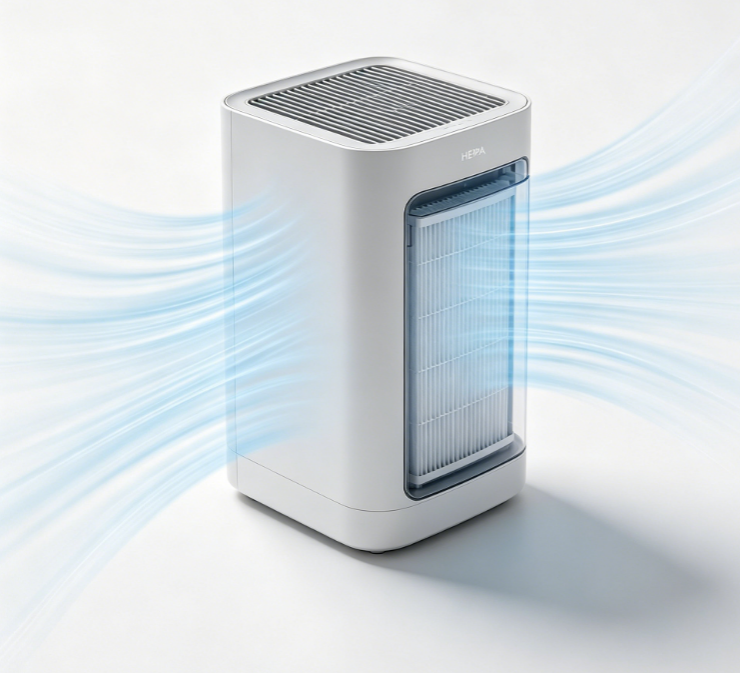
What Is HEPA Technology and How Does It Work?
HEPA stands for High-Efficiency Particulate Air. At its core, a HEPA filter is a dense mat of randomly arranged fibers — typically borosilicate glass or polypropylene — that traps airborne particles through four distinct physical mechanisms:
- • Interception — Particles following the airstream come within one particle radius of a fiber and stick to it.
- • Impaction — Larger particles cannot follow the curved airstream around fibers and collide directly with them.
- • Diffusion — The smallest particles (below 0.1 µm) exhibit Brownian motion, zigzagging randomly until they contact a fiber.
- • Sieving — Particles larger than the gaps between fibers are physically blocked. This is the simplest mechanism and least significant for true HEPA filtration.
Contrary to popular belief, HEPA filters do not work like a fine sieve. A particle must navigate a complex labyrinth of fibers where multiple capture mechanisms operate simultaneously. This is why the filter’s efficiency actually peaks at a certain particle size — approximately 0.3 microns, known as the Most Penetrating Particle Size (MPPS) — and actually increases for both smaller and larger particles.
HEPA Filter Efficiency Standards: From H10 to H14
Not all HEPA filters are created equal. The EN 1822 standard (Europe) and ISO 29463 define filter classes that B2B buyers must understand when comparing supplier specifications:
|
Filter Class |
Efficiency @ MPPS |
Common Name |
Typical B2B Application |
|
E10 |
≥ 85% |
EPA |
Budget consumer purifiers, entry-level markets |
|
E11 |
≥ 95% |
EPA |
Mid-range home purifiers, basic office units |
|
E12 |
≥ 99.5% |
EPA |
Premium home purifiers, office-grade |
|
H13 |
≥ 99.95% |
HEPA |
Medical-grade, allergy-focused, commercial B2B |
|
H14 |
≥ 99.995% |
HEPA |
Hospital ORs, cleanrooms, pharmaceutical manufacturing |
Key takeaway for B2B buyers: The difference between H13 and H14 may appear small numerically (0.045%), but in practice H14 filters are significantly more expensive to manufacture while delivering marginally better performance for most non-medical applications. For 95% of consumer and commercial air purifier applications, H13 HEPA represents the optimal balance of cost and performance.
Why HEPA Dominates: Six Reasons No Competing Technology Has Dethroned It
The global air purifier market was valued at approximately $15.8 billion in 2025 and is projected to reach $23.2 billion by 2030. HEPA-based purifiers command an estimated 72-78% of this market. Why? Here are the six structural advantages that have kept HEPA at the top:
1. Universally Recognized Certification Standards
HEPA is backed by EN 1822, ISO 29463, IEST-RP-CC001, and MIL-STD-282 — a regulatory framework spanning Europe, North America, and Asia. No competing air purification technology (ESP, ionizer, photocatalyst) has achieved comparable standardization, making HEPA the safest choice for regulatory compliance across multiple markets.
2. Scientifically Provable Performance
HEPA efficiency can be measured, certified, and verified by third-party labs. A supplier claiming 99.97% H13 filtration can be audited. Compare this to ionizer manufacturers who claim to ‘reduce odors’ or UV-C brands that claim to ‘kill 99.9% of germs’ — these claims are far harder to standardize and verify across different testing conditions.
3. No Harmful Byproducts
This is a critical differentiator. Ionizers generate ozone as a byproduct — a known lung irritant that the California Air Resources Board (CARB) strictly regulates. Electrostatic precipitators can also produce trace ozone. HEPA filters produce zero byproducts. They are purely mechanical — air passes through, particles get trapped, clean air exits. For markets like the EU and USA, where ozone emissions are tightly regulated, HEPA is the compliance-safe choice.
4. Scalable Manufacturing Economics
HEPA filter media is a commodity. The raw materials — glass fiber or polypropylene — are widely available and relatively inexpensive. The manufacturing process is well-established and scalable. For B2B buyers placing orders of 500+ units, the per-unit cost of a H13 HEPA filter is highly predictable and competitive.
5. Consumer Trust and Brand Recognition
“HEPA” is one of the few technical terms that has crossed over into consumer vocabulary. End customers actively search for it, trust it, and are willing to pay a premium for it. From a B2B brand-building perspective, putting “True HEPA” on your product box instantly communicates value in any language — no consumer education required.
6. Compatibility with Multi-Stage Systems
HEPA is not an either/or choice. Modern 6-stage air purifiers layer HEPA with pre-filters, activated carbon, UV-C, ionizers, and cold catalyst — creating a synergistic filtration system. HEPA handles particulates; the other stages handle gases, odors, and microorganisms. This modularity makes HEPA the ideal foundation for high-margin, feature-rich B2B products.
HEPA vs. Competing Technologies: A B2B Comparison Matrix
For B2B buyers evaluating which technology to build their product line around, here is a direct comparison:
|
Factor |
HEPA |
ESP |
Ionizer |
UV-C |
Photocatalyst |
| Particle Removal |
★★★★★ |
★★★★ |
★★★ |
★★ |
★★ |
| Gas/Odor Removal |
★★ (w/ Carbon) |
★★ |
★★★ |
★ |
★★★★ |
| No Byproducts |
★★★★★ |
★★★★ |
★★ |
★★★★★ |
★★★★ |
| Certification Ready |
★★★★★ |
★★★ |
★★ |
★★★ |
★★ |
| Consumer Trust |
★★★★★ |
★★★ |
★★ |
★★★ |
★★ |
| Filter Cost/Unit |
$3-8 |
$0 (washable) |
$0 |
$1-3* |
$2-4* |
| OEM Complexity |
Low-Moderate |
Moderate |
Low |
Moderate |
High |
| B2B Margin Potential |
High |
Medium |
Low |
Medium |
Low-Med |
*UV-C lamps and photocatalyst coatings require periodic replacement on 12-24 month cycles.
How B2B Buyers Should Evaluate HEPA Air Purifier Suppliers
When sourcing HEPA air purifiers from Chinese manufacturers, five evaluation criteria separate reliable long-term partners from transactional suppliers:
1. Filter Grade Transparency
Ask the supplier to specify the exact HEPA class (H12, H13, H14) with supporting test reports from an accredited lab. Beware of suppliers who use vague terms like ‘HEPA-type’ or ‘HEPA-like’ — these are red flags indicating sub-standard filtration media. A legitimate supplier will provide a test certificate showing efficiency at MPPS.
2. Filter Media Sourcing
The quality of the HEPA filter media directly determines the purifier’s performance. Top-tier Chinese manufacturers source media from established suppliers like H&V (Hollingsworth & Vose), Ahlstrom-Munksjö, or domestic equivalents with equivalent certifications. During factory audits, ask to see incoming material quality records and supplier qualification documents.
3. CADR and Air Flow Testing
A HEPA filter is only as good as the system it’s installed in. The Clean Air Delivery Rate (CADR) measures the actual clean air output of the complete purifier — filter + fan + housing. A supplier who can provide independently verified CADR test data (preferably from a lab like Intertek, SGS, or TÜV) demonstrates engineering competence beyond just assembling parts.
4. Multi-Market Certification Portfolio
For B2B buyers serving multiple markets, a supplier’s existing certification portfolio is a critical efficiency lever. A factory that already holds UL (USA), CE (EU), CB (international), KC (Korea), PSE (Japan), and BIS (India) certifications can save you 6-18 months of certification lead time compared to a supplier seeking these for the first time.
5. OEM Filter Customization Capability
Can the manufacturer customize the filter dimensions, media grade, frame material, and gasket seal for your brand’s specific product design? Leading OEM partners maintain in-house filter production lines, enabling rapid prototyping and cost-effective custom filter solutions — a significant competitive advantage for brand owners.
AirDow’s HEPA Air Purifier Manufacturing: What Sets Us Apart
At ADA Electrotech (Xiamen) Co., Ltd. — operating under the international brand AirDow — we have been manufacturing HEPA-based air purifiers since 1997. With 27+ years of continuous production experience, our capabilities include:
- • Full in-house vertical integration: injection molding, filter production, PCB assembly, and final product assembly — all under one 20,000+ sqm roof.
- • H13 HEPA as our standard filtration grade across all product lines, with H14 available for medical-grade applications.
- • Multi-certification ready: UL, CE, FCC, CB, KC, GS, PSE, RoHS, and ISO 9001:2015 certified factory.
- • Annual production capacity exceeding 700,000 units with 35-45 day standard lead times for bulk OEM orders.
- • OEM/ODM flexibility: custom filter dimensions, housing design, color, branding, packaging, and voltage configuration for any target market.
Whether you are launching a private-label HEPA air purifier brand, expanding your distributor catalog, or sourcing for a specific commercial project — AirDow provides the manufacturing expertise, certification coverage, and supply chain reliability that B2B buyers depend on.
Frequently Asked Questions About HEPA Air Purifier Technology
Q: What is the difference between True HEPA and HEPA-type filters?
True HEPA filters meet the EN 1822 or IEST standard of ≥99.95% efficiency at 0.3 microns. ‘HEPA-type’ or ‘HEPA-like’ filters have no standardized definition and typically achieve only 85-95% efficiency. For B2B buyers, always specify ‘H13 True HEPA’ in your RFQ to ensure you receive genuine certified filtration media.
Q: How often should HEPA filters be replaced in commercial applications?
In typical office or commercial environments running 8-12 hours daily, HEPA filters should be replaced every 6-12 months. Heavy-use environments (restaurants, smoking lounges, industrial settings) may require 3-6 month replacement cycles. Filter change indicator lights and PM2.5 sensor-equipped units can optimize replacement timing and reduce unnecessary filter waste.
Q: Can HEPA filters remove viruses like COVID-19 or influenza?
Yes. Coronavirus particles measure approximately 0.1-0.14 microns — well within the capture range of H13 HEPA filters. However, HEPA filtration should be considered one layer of a multi-layered indoor air quality strategy, alongside adequate ventilation and, where appropriate, supplementary UV-C sterilization. The U.S. CDC and ASHRAE both recommend HEPA filtration as an effective engineering control for airborne pathogen reduction.
Q: Why do some markets prefer washable ESP filters over HEPA?
Electrostatic Precipitator (ESP) filters are washable and reusable, eliminating recurring filter replacement costs. This appeals to price-sensitive markets and consumers seeking lower long-term maintenance. However, ESP filters typically achieve lower single-pass efficiency than HEPA and may produce trace ozone. The trade-off is lower upfront operating cost versus superior filtration performance. In our experience, most B2B buyers stock both technologies to address different market segments — HEPA for premium/mid-range and ESP for entry-level/price-sensitive positioning.
Conclusion: HEPA Is Not Going Anywhere — And B2B Buyers Should Bet on It
The air purifier market continues to evolve rapidly, with IoT connectivity, smart sensors, and multi-stage systems pushing the boundaries of what air purifiers can do. But at the heart of nearly every high-performance unit — from a $50 desktop model to a $2,000 commercial installation — sits a HEPA filter.
HEPA has earned its dominance through decades of scientific validation, international standardization, manufacturing scalability, and consumer trust. For B2B buyers, betting on HEPA is not a gamble — it is the safest, most defensible strategic choice you can make for your air purifier product line in 2026 and beyond.
Ready to source HEPA air purifiers for your market? Contact Locke at locke@airdow.com or visit www.airdow.com to discuss OEM/ODM requirements.
━━━━━━━━━━━━━━━━━━━━━━━━━━━━━━━━━━━━━━━━━━━━━━━━━━━━━━━━━━━━━━━━━━━━━━━━━━━━━━━About the Author
Locke is a Senior Sales Representative at ADA Electrotech (Xiamen) Co., Ltd. (brand: AirDow), specializing in B2B air purifier export to Southeast Asia, South Asia, and Japan. With 4+ years of hands-on experience in OEM air purifier sourcing, factory audits, and international trade shows (Canton Fair, HK Electronics Fair), Locke helps importers, distributors, and brand owners navigate the complete procurement lifecycle — from product selection and certification compliance to logistics coordination and after-sales support. He has facilitated AirDow’s market entry into India, Thailand, Indonesia, Singapore, and Japan.
Post time: Jun-02-2026


