
Modern homes are built airtight to save energy. The problem: airtight homes trap stale air, moisture, and pollutants. An energy recovery ventilator (ERV) solves both problems at once.
An ERV is a whole-home ventilation system that continuously exchanges indoor and outdoor air while recovering up to 85% of the heating or cooling energy from the exhaust air. It brings fresh, filtered outdoor air in and pushes stale indoor air out — without throwing your energy bills out the window. For new airtight construction, an ERV (or HRV) is no longer optional; it is required by building codes in many regions.
This guide explains how home ERV systems work, the difference between ERV and HRV, sizing and installation considerations, costs, and maintenance — with practical guidance for homeowners and B2B buyers alike.
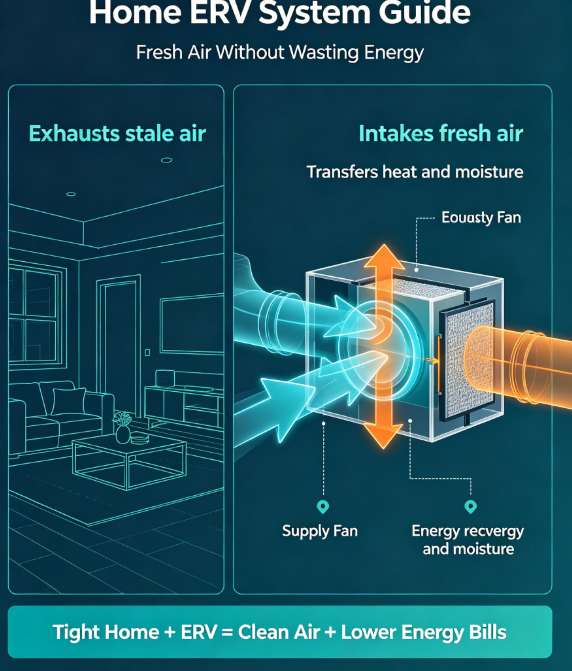
What Is a Home ERV System?
An energy recovery ventilator is a mechanical ventilation unit with four key components: two fans (supply and exhaust), an energy recovery core, filters, and duct connections. It operates continuously or on schedule, providing balanced ventilation: for every cubic meter of stale indoor air exhausted, an equal volume of fresh outdoor air is brought in.
The energy recovery core is the heart of the system. As the two air streams pass through it in opposite directions (counter-flow design), heat — and in ERVs, moisture — transfers from the warmer stream to the cooler one. In winter, warm exhaust air pre-heats cold incoming air; in summer, cool exhaust air pre-cools hot incoming air.
ERV vs HRV: Which One Does Your Home Need?
The choice between an ERV and an HRV depends mainly on your climate:
|
Feature |
HRV |
ERV |
Best For |
| Transfers | Heat only | Heat + moisture | Climate-dependent |
| Winter effect | Keeps indoor humidity | Preserves indoor moisture | Dry cold climates: ERV |
| Summer effect | Brings in humid air | Blocks outdoor humidity | Humid climates: ERV |
| Core type | Aluminum/plastic plate | Enthalpy (membrane) core | Membrane core costlier |
| Efficiency | 70-90% sensible heat | 60-85% + latent (moisture) | Similar |
| Cold climates | Standard choice | Can freeze core at very low temps | HRV below -10°C extremes |
| Humid climates | May raise indoor humidity | Prevents humidity intrusion | ERV preferred |
| Price range | $800-2,500 | $1,000-3,000 | Similar |
Rule of thumb: choose an ERV for climates with significant humidity concerns (hot-humid summers or very dry winters). Choose an HRV for cold northern climates where winter humidification is managed separately.
How an ERV Works — Step by Step
1. Supply fan draws outdoor air through an intake vent, pulling it into the ERV unit.
2. Intake air passes through a filter (MERV 8-13 typical; some units accept HEPA) removing particles before the air enters the home.
3. Both the filtered supply air and the exhaust air pass through the energy recovery core in counter-flow. Heat and moisture transfer between them without air mixing.
4. The conditioned supply air is distributed to living areas (bedrooms, living room) through supply ducts.
5. Exhaust fan draws stale air from kitchens, bathrooms, and utility rooms through return ducts.
6. Stale air passes through the core (giving up its energy), then is expelled through the exterior exhaust vent.
Crucial detail: the two air streams never mix inside the core. Only heat and moisture pass through the membrane or plates. This ensures odors and pollutants from the exhaust stream do not enter the supply air.
Sizing a Home ERV: Airflow Requirements
ERV sizing is expressed in cubic feet per minute (CFM) or cubic meters per hour (m³/h). Two standard sizing methods:
• ASHRAE 62.2 method — The US standard: required ventilation = 0.01 × floor area (ft²) + 7.5 × (bedrooms + 1). A 2,000 ft², 3-bedroom home needs approximately 0.01×2000 + 7.5×4 = 50 CFM continuous.
• Air changes per hour (ACH) — 0.3-0.5 ACH is typical for whole-home ventilation. A 300 m² home with 2.7m ceilings (810 m³ volume) needs 240-400 m³/h at 0.3-0.5 ACH.
• Practical guidance — Choose a unit rated at 1.5-2x the calculated requirement to allow for filter loading and duct losses. Oversizing with variable-speed motors is better than undersizing.
Installation Considerations
• Best installed during construction or renovation — Ducting is easiest to run through open walls and ceilings. Retrofit installations are possible but more expensive.
• Duct design matters — Supply ducts to bedrooms and living areas; exhaust ducts from kitchens, bathrooms, and laundry. Balanced duct runs minimize pressure imbalance.
• Condensate drain — In humid climates, ERVs produce condensate that needs a drain line to a floor drain or condensate pump.
• Exterior vents — Intake and exhaust vents should be separated (typically 1.5-3m apart) to prevent short-circuiting of exhausted air back into the intake.
• Frost protection — In very cold climates, HRVs/ERVs need frost control (pre-heater or core bypass) to prevent core freezing.
Costs: Purchase, Installation, and Operation
• Equipment cost — $800-3,000 depending on capacity, core type (ERV costs more than HRV), and brand. Premium units with sensors, WiFi control, and bypass modes cost more.
• Installation — $1,500-4,000 for a ducted whole-home system in new construction. Retrofit installations can add 50-100% to labor costs.
• Operating cost — Two small fans running continuously consume roughly 50-150W total, about $5-20 per month in electricity depending on rates. Energy recovery saves far more in heating/cooling than the fans consume.
• Maintenance — Filter replacement every 3-6 months ($15-40 per set), core cleaning annually (some cores are washable; enthalpy membrane cores have a 10-15 year lifespan before replacement).
Measured Benefits of Continuous Ventilation
✓ CO2 control — A 4-person household generates 4-6 L/hour of CO2. Without ventilation, bedroom CO2 can exceed 2,000-3,000 ppm overnight; with an ERV running, levels stay below 800-1,000 ppm. Elevated CO2 is linked to reduced cognitive performance and poor sleep.
✓ Moisture control — ERVs remove excess humidity in summer and preserve it in winter, reducing mold risk and protecting the building structure.
✓ Pollutant dilution — Continuous air exchange dilutes indoor-generated VOCs (from furniture, cleaning products) that purifiers alone cannot fully eliminate.
✓ Energy savings vs. opening windows — Unlike open windows, an ERV conditions incoming air, recovering 70-85% of the energy that would otherwise be lost.
✓ Quiet comfort — Modern ERVs operate at 30-40 dB in low mode — quieter than a window open to traffic noise.
ERV + Air Purifier: The Complete Indoor Air Solution
An ERV brings fresh air in; an air purifier deeply cleans the air that recirculates indoors. Together they cover the full spectrum:
• ERV handles: CO2, oxygen renewal, humidity balance, whole-home fresh air delivery, and basic particle filtration on intake.
• Air purifier handles: High-efficiency particle removal (HEPA), gas/VOC adsorption (carbon), and room-level rapid response to pollution spikes.
• Recommended pairing: ERV for continuous whole-home baseline ventilation + portable purifiers in bedrooms and living areas where occupants spend the most time.
Conclusion: Is a Home ERV Worth It?
For airtight modern homes, an ERV is the difference between energy efficiency and living in a sealed box. The verdict:
1. ERVs deliver continuous fresh air with 70-85% energy recovery, solving CO2, humidity, and pollutant buildup in airtight homes
2. Choose ERV (heat + moisture transfer) for humid or very dry climates; HRV (heat only) for moderate or cold climates
3. Size using ASHRAE 62.2 or 0.3-0.5 ACH, then select a unit rated 1.5-2x higher to account for filters and duct losses
4. Total installed cost of $2,500-7,000 is justified for new construction by code compliance, health benefits, and energy savings
5. For the best indoor air quality, pair an ERV (fresh air baseline) with HEPA air purifiers (deep filtration) in occupied rooms
Looking for ERV units, fresh air ventilators, or complementary air purifiers for your product line? Contact us at ada5@airdow.com for OEM specifications, sizing support, and solution design consultation.
Post time: Sep-08-2026


