
Your air purifier is running at home — but you are at the office. Is the air quality good? Did you leave it on high speed all day? With an IoT air purifier, the answer is on your phone.
IoT (Internet of Things) connectivity has transformed air purifiers from standalone appliances into connected devices that users can monitor, schedule, and control from anywhere. The Tuya Smart platform has become the de facto standard for OEM air purifier connectivity, offering ready-made app infrastructure, cloud services, and smart home ecosystem compatibility — without requiring manufacturers to build their own IoT stack from scratch.
For B2B buyers, understanding IoT integration options is now essential for competitive product planning. This guide covers the core features of IoT air purifiers, how Tuya Smart integration works, hardware and certification requirements, and what to consider when adding connectivity to your product line.
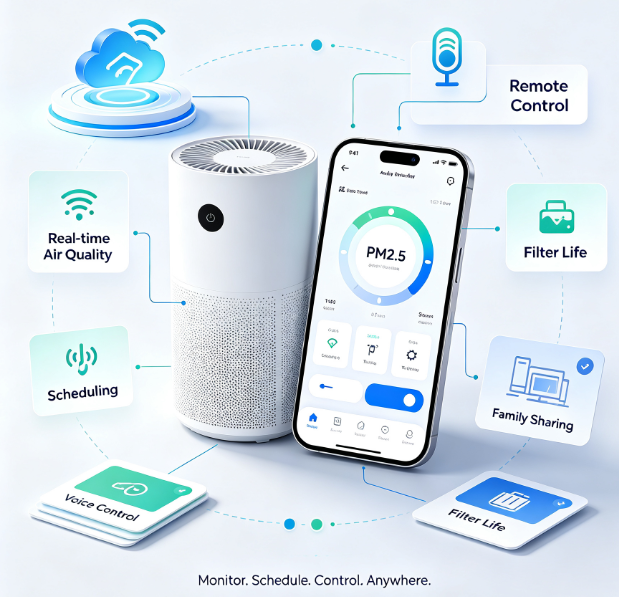
Core Features of an IoT Air Purifier
IoT connectivity adds a layer of features that significantly change how users interact with air purifiers:
✓ Remote on/off and fan speed control — The most-used feature. Users can turn the purifier on before arriving home or adjust speed from anywhere with internet access.
✓ Real-time air quality monitoring — Live PM2.5, temperature, and humidity readings stream to the app, with historical trend charts showing air quality over hours, days, or weeks.
✓ Scheduling and automation — Users set daily schedules (e.g., high speed 7:00-9:00 AM, sleep mode 10:00 PM-6:00 AM) or create automation rules based on air quality thresholds.
✓ Smart home voice control — Alexa, Google Assistant, and Tuya ecosystem compatibility: “Alexa, turn on the purifier” or “set purifier to turbo mode.”
✓ Filter life monitoring — The app tracks runtime and estimated filter remaining life, sending push notifications when replacement is due. This drives filter sales and customer retention.
✓ Family sharing and multi-device management — Multiple users can control the same device; one app manages all smart devices in the home.
Why Tuya Smart Is the Industry Standard for OEM Air Purifiers
Tuya Smart is a global IoT platform providing hardware modules, cloud infrastructure, and white-label mobile apps. It dominates the air purifier OEM market for several reasons:
• Speed to market — OEMs can add Tuya connectivity in 2-4 weeks using pre-certified WiFi modules and reference designs, versus 6-12 months building a custom IoT stack.
• No app development required — Tuya provides white-label apps (Tuya Smart / Smart Life) with 100,000+ daily active users, or fully customizable apps for brands that want their own identity.
• Global cloud infrastructure — Tuya operates data centers across regions (US, EU, Asia), supporting worldwide deployment with local data residency compliance.
• Certification support — Tuya modules come pre-certified (FCC, CE, RCM, TELEC), reducing per-product certification cost and timeline.
• Ecosystem compatibility — Tuya devices natively integrate with Amazon Alexa, Google Home, and Apple HomeKit (via additional hardware), covering major smart home ecosystems.
• Cost efficiency — WiFi module costs for OEM volumes are typically $2-4, making IoT connectivity affordable even for mid-range products.
How Tuya Smart Integration Works — The Technical Architecture
The IoT architecture for a Tuya-enabled air purifier has four layers:
• Device layer — The purifier main MCU controls fan, sensors, and display. A Tuya WiFi module (e.g., WB3S, T2-U) handles connectivity via UART serial using the Tuya protocol.
• Network layer — The WiFi module connects to the user router (2.4GHz, 802.11 b/g/n). Note: Tuya modules do not support 5GHz WiFi — a common setup consideration.
• Cloud layer — The module communicates with Tuya cloud over TLS-encrypted MQTT/HTTP. All device states, commands, and telemetry pass through here.
• Application layer — The Tuya Smart app (or brand-customized app) and voice assistants (Alexa, Google) interact with the cloud to control the device.
Data flow example: User taps “Turbo” in the app → command goes to Tuya cloud → cloud sends to the device WiFi module over MQTT → module forwards via UART to the main MCU → MCU drives the fan at full speed → device state updates back to cloud → app confirms. Total round-trip latency is typically 300-800ms.
OEM Hardware Requirements for IoT Air Purifiers
Adding Tuya connectivity requires careful hardware planning:
• WiFi module selection — Tuya-certified modules (WB3S, CB3S, T2-U) integrate directly with Tuya cloud. ESP8266/ESP32-based modules are also widely used with Tuya firmware.
• Antenna design — PCB antenna modules are cheapest but sensitive to placement; external antenna modules offer better range. Keep antenna away from metal shielding and motor EMI sources.
• MCU requirements — The main MCU needs spare UART pins and sufficient flash/RAM for the Tuya protocol stack. Most 8-bit or 32-bit MCUs in purifiers are sufficient.
• Power supply — WiFi transmission bursts draw up to 300mA at 3.3V. The power supply must handle these peaks without voltage droop causing resets.
• EMC compliance — WiFi modules add RF emissions. Products need re-testing for FCC/CE EMC with the module installed. Tuya pre-certified modules reduce this burden.
Security and Privacy Considerations
IoT devices are a common entry point for network attacks. Key security measures for Tuya-enabled air purifiers:
• TLS encryption — All Tuya cloud communication uses TLS 1.2+, protecting commands and telemetry from interception.
• Device authentication — Each device has a unique UUID and local key burned at manufacturing, preventing unauthorized device impersonation.
• OTA firmware updates — Tuya supports over-the-air updates for the WiFi module and (with proper design) the main MCU, allowing security patches post-sale.
• Data minimization — Only operational data (device state, air quality readings) is transmitted. No microphone or camera data in standard purifier IoT designs.
Certification and Compliance for Connected Air Purifiers
IoT air purifiers require additional compliance beyond standard electrical safety:
✓ Radio certification — WiFi modules need FCC (US), CE-RED (EU), RCM (Australia), MIC/TELEC (Japan), SRRC (China). Tuya pre-certified modules can be reused under most schemes.
✓ App store requirements — Custom-branded apps need Apple App Store and Google Play privacy policy and data collection disclosure compliance.
✓ Data protection — GDPR (EU) and CCPA (California) compliance for apps handling user accounts. Tuya EU data center helps with GDPR data residency.
✓ Energy efficiency — WiFi standby power affects ERP (EU) and Energy Star (US) compliance. Design for <1W standby with WiFi in low-power mode.
The Business Case: Why IoT Connectivity Justifies the Cost
For B2B buyers weighing the $2-5 BOM cost increase of adding WiFi, the business case extends beyond the retail price premium:
✓ Higher retail margins — IoT-enabled purifiers command 20-40% higher retail prices than equivalent non-connected models.
✓ Filter consumables revenue — App-based filter monitoring drives repeat filter purchases through push notifications. Filter sales can generate 2-3x the profit of the initial unit over its lifetime.
✓ Brand app ecosystem — A white-label app keeps users engaged with the brand daily, creating cross-sell opportunities for other smart home products.
✓ Data insights — Aggregated usage data (anonymized) reveals which features users actually use, guiding future product development.
✓ Competitive parity — In mature markets (US, EU, China), a non-connected purifier is increasingly seen as outdated by consumers.
Limitations and Considerations
✗ 2.4GHz only — Tuya modules do not support 5GHz WiFi. Users with mesh routers must ensure the 2.4GHz band is enabled.
✗ Cloud dependency — If Tuya cloud has an outage, remote control and voice commands stop working. Local physical controls always remain functional.
✗ Setup friction — First-time WiFi pairing can confuse non-technical users. QR-code pairing and Bluetooth-assisted setup reduce this friction.
✗ HomeKit requires extra hardware — Native Apple HomeKit support needs a separate bridge module, adding cost. Alexa and Google work directly.
Conclusion: Making the IoT Decision
IoT connectivity has become a defining feature in the air purifier market. For B2B buyers, the decision is no longer whether to offer connected products — it is how to integrate connectivity efficiently and cost-effectively.
1. Tuya Smart integration is the fastest and most cost-effective path to IoT connectivity, with 2-4 week integration timelines and pre-certified modules
2. Core feature set (remote control, scheduling, AQI monitoring, filter alerts) covers 90%+ of consumer demand; voice assistant support is table stakes in US/EU markets
3. WiFi module BOM cost of $2-5 is justified by 20-40% retail price premiums and recurring filter revenue
4. Radio certifications (FCC/CE/RCM) and app store compliance add 4-8 weeks to product timelines — plan accordingly
5. For private-label brands, a white-label Tuya app provides an immediate branded experience without app development costs
Interested in adding Tuya Smart IoT connectivity to your air purifier line? Contact us at ada5@airdow.com for WiFi module options, integration support, and connected product design consultation.
Post time: Aug-04-2026


