
What if an air filter could capture more particles while letting air flow through more easily? That is exactly what nano technology makes possible.
Nano air purification refers to a family of technologies that operate at the nanometer scale (1-100 nm) to enhance air cleaning performance. The three most commercially significant applications are nanofiber filter media, nano photocatalytic coatings, and nano-silver antimicrobial layers. Each addresses a specific limitation of conventional air purification — and together they represent the next generation of air purifier technology.
For B2B buyers, nano-enabled products command premium positioning but also require careful supplier evaluation. This article explains how each nano technology works, its measurable performance advantages, and what to verify before integrating nano claims into your product line.
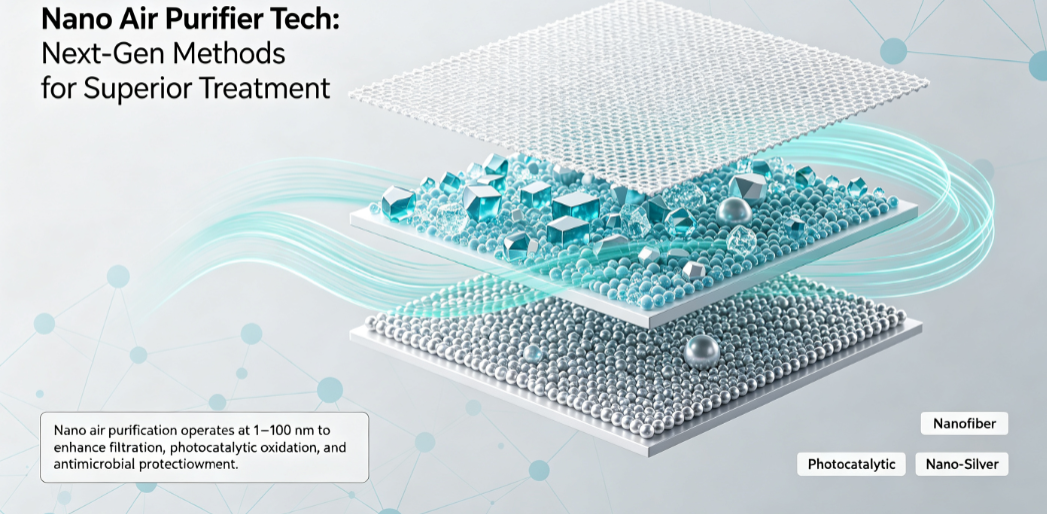
Nanofiber Filter Media: Thinner Fibers, Better Performance
Conventional HEPA filters use microfibers with diameters of 5-30 µm. Nanofiber media uses electrospun fibers with diameters of 50-500 nm — 100 times thinner. This dramatic fiber refinement changes the filtration physics:
Why Fiber Diameter Matters
• More fibers per unit area — Thinner fibers mean a denser fiber network in the same volume, creating more capture surfaces for particles.
• Slip-flow effect — At nanofiber scale, air molecules begin to “slip” past fiber surfaces instead of flowing around them, reducing air resistance. This is the key to higher efficiency at lower pressure drop.
• Higher efficiency at lower pressure drop — Nanofiber HEPA can achieve the same 99.97% efficiency as conventional HEPA with 30-50% less airflow resistance, or higher efficiency (up to 99.99%+) at the same resistance.
• Energy savings — Lower pressure drop means the fan works less. In a typical purifier, this translates to 10-20% lower energy consumption at the same CADR.
Commercial Nanofiber Applications
✓ Electrostatic nanofiber layers — Added upstream of conventional HEPA, these charged nanofiber layers capture fine particles while protecting the main HEPA, extending its life.
✓ Nanofiber HEPA replacement — Full nanofiber HEPA media (e.g., N95-grade electrospun media) is now available at competitive cost for consumer purifiers.
✓ Car cabin filters — Nanofiber media is widely adopted in automotive cabin air filters for its low pressure drop, which matters in vehicle HVAC systems.
Nano Photocatalytic Coatings: More Surface, Faster Breakdown
Photocatalyst technology (TiO₂ + UV) was covered in our earlier technology guide. Nano engineering takes it further: when TiO₂ is manufactured at nanoparticle scale (10-50 nm), its specific surface area increases dramatically — up to 200-300 m²/g versus 10-50 m²/g for conventional coatings.
• More active sites — Higher surface area means more catalytic reaction sites per gram of material, increasing the rate of VOC and formaldehyde breakdown.
• Quantum size effects — At <10 nm, TiO₂ band gap widens slightly, which can shift UV activation requirements. Most commercial nano TiO₂ still uses UV-A activation.
• Transparent coatings — Nano TiO₂ can be applied as transparent thin films, allowing it to coat the inner surfaces of the purification chamber or the HEPA filter itself without blocking airflow.
• Self-cleaning surfaces — Nano TiO₂ coatings are photocatalytic and hydrophilic, meaning organic contaminants on coated surfaces are continuously oxidized. This reduces filter odor buildup.
Nano-Silver Antimicrobial Layers: Preventing Filter Contamination
One of the hidden problems with air purifiers: captured bacteria and mold can grow on the filter media itself, turning the filter into a pollution source. Nano-silver (silver nanoparticles, 1-100 nm) addresses this with continuous antimicrobial action:
• Mechanism — Silver nanoparticles release Ag+ ions that bind to bacterial cell membranes and enzymes, disrupting metabolism and preventing reproduction. Effective against bacteria, fungi, and some viruses.
• Application — Nano-silver is embedded in filter media fibers during manufacturing or applied as a surface coating on HEPA and pre-filters.
• Duration — Silver ions release slowly over the filter’s lifetime. Well-formulated nano-silver coatings maintain antimicrobial efficacy for 12-24 months.
• Safety — Nano-silver in filter media is not released into the air stream in meaningful quantities when properly bonded. EU Biocidal Products Regulation (BPR) compliance should be verified for EU markets.
Nano Technology Comparison for B2B Product Planning
|
Technology |
Primary Benefit |
Best Application |
Cost Impact |
| Nanofiber media | Higher efficiency, lower pressure drop | HEPA stage, car cabin filters | +$2-5 per filter |
| Nano TiO₂ coating | Faster VOC/formaldehyde breakdown | Catalyst stage, chamber surfaces | +$1-3 per unit |
| Nano-silver layer | Antimicrobial filter protection | Pre-filter, HEPA media | +$1-2 per filter |
| Combined nano system | All three benefits | Premium 6-stage purifiers | +$5-10 per unit |
How to Verify Nano Technology Claims
“Nano” is one of the most overused marketing terms in the air purification industry. Verification is essential:
✓ Nanofiber claims — Request SEM (scanning electron microscope) images of the filter media showing fiber diameters. Actual nanofiber media should show fibers <1 µm. Also verify efficiency and pressure drop test reports (EN 1822 / GB/T 6165).
✓ Nano TiO₂ claims — Request particle size analysis (BET surface area or TEM images) and formaldehyde/VOC removal test data showing the nano coating’s incremental contribution.
✓ Nano-silver claims — Request antimicrobial test reports (ISO 22196 or JIS Z 2801) showing log reduction values against specific organisms (e.g., E. coli, S. aureus, Aspergillus niger).
✓ Certification — For EU markets, verify biocidal claims comply with BPR. For US markets, avoid unsubstantiated health claims that could trigger FTC action.
Limitations and Realistic Expectations
✗ Cost premium — Nano-enabled filters cost 20-50% more than conventional equivalents. The performance gain must justify the price in your target market.
✗ Not a replacement technology — Nano enhancements improve existing stages; they do not eliminate the need for carbon (gases) or UV-C (pathogens) stages.
✗ Durability questions — Nano-silver efficacy declines over filter life; nanofiber media can be more fragile than microfiber media during handling and pleating.
✗ Market skepticism — Consumer fatigue with “nano” marketing claims means your verification data must be genuinely credible and communicable.
Conclusion: Positioning Nano Technology in Your Product Line
Nano technology delivers real, measurable improvements in air purification — but only when implemented with genuine engineering and verified by credible test data.
1. Nanofiber media offers the most compelling value: meaningful efficiency/pressure-drop improvement at modest cost, with strong story value for premium positioning
2. Nano TiO₂ coatings enhance catalyst-stage performance and are most valuable in markets where formaldehyde removal is a top consumer concern
3. Nano-silver antimicrobial layers address the under-appreciated problem of filter contamination, extending filter life and reducing odor complaints
4. Always demand third-party verification (SEM, BET, ISO 22196, EN 1822) before accepting nano performance claims from suppliers
5. Combined nano systems justify 15-30% retail price premiums in premium segments when backed by transparent, testable performance data
Interested in integrating nano technology into your air purifier line? Contact us at ada5@airdow.com for nanofiber filter samples, nano coating specifications, and third-party test reports.
Post time: Aug-18-2026


