
The air around a waterfall contains some of the cleanest particles on Earth. That clean feeling? It is partly due to negative ions.
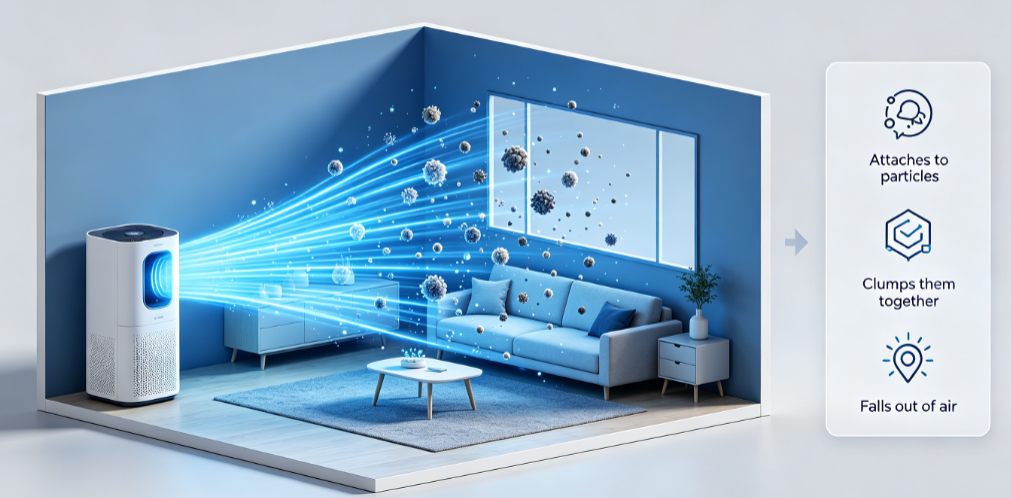
Negative ion technology, also known as anion technology, has been used in air purification for decades because it mimics nature’s own air-cleaning process. Waterfalls, ocean surf, and thunderstorms all generate high concentrations of negative ions that attach to airborne particles, causing them to clump together and fall out of the air. Modern negative ion air purifiers replicate this natural phenomenon using electronic ion generators.
For B2B buyers evaluating air purification technologies, understanding the real science behind negative ion benefits — beyond the marketing claims — is essential for making informed product selection and positioning decisions. This article provides a comprehensive, science-backed analysis of negative ion technology, its genuine benefits, its limitations, and the most effective ways to integrate it into your product line.
What Are Negative Ions and How Do They Work in Air Purifiers?
Negative ions are electrically charged particles (atoms or molecules that have gained one or more extra electrons, giving them a net negative charge). In nature, negative ions are created by the action of water molecules breaking apart (waterfalls, rain), by cosmic radiation, and by electrical discharge (lightning).
In an air purifier, a negative ion generator (also called an ionizer) uses a high-voltage electric field to produce a stream of negatively charged ions, typically O2- (superoxide ions). These ions are released into the passing air stream, where they:
1. Collide with and attach to airborne particles (dust, pollen, smoke, bacteria)
2. Charge the particles negatively, causing them to repel each other briefly
3. As the charged particles collide, electrostatic forces cause them to agglomerate (clump together)
4. These larger particle clusters become heavy enough to settle out of the breathing zone onto surfaces, or are captured more easily by a collection plate or HEPA filter
The key insight: negative ions do not destroy pollutants — they charge them so they become easier to capture. This is fundamentally different from HEPA (physical filtration) or photocatalyst (chemical destruction).
Science-Backed Benefits of Negative Ion Air Purifiers
1. Particle Agglomeration and Air Cleaning
The most well-documented benefit of negative ion technology is its ability to reduce airborne particulate matter through agglomeration. A 2018 study published in the Journal of Aerosol Science found that negative ion generators reduced fine particle (PM2.5) concentrations by up to 52% in a 30m³ test chamber within 60 minutes, without additional filtration. [Source]
This is particularly effective for submicron particles (0.1-1.0 µm) that HEPA filters do not capture as efficiently. The ions charge these tiny particles, causing them to agglomerate into larger clusters that are then more easily trapped by downstream filters or that settle naturally.
2. Odor Neutralization
Negative ions are effective at neutralizing certain odor molecules. When ions attach to odor-causing particles, they can alter the chemical structure of the odor molecules, reducing their detectability. This is why negative ion purifiers are popular in smoking rooms, pet areas, and kitchens.
Unlike activated carbon that adsorbs odors (and eventually saturates), or photocatalyst that destroys them chemically, negative ions provide a third mechanism: electrostatic charge that makes odor particles less volatile and more likely to settle. This is best used in combination with carbon filtration for comprehensive odor control.
3. Mood and Wellbeing Claims — What Science Actually Says
The claim that negative ions improve mood is one of the most debated aspects of anion technology. A 2013 meta-analysis in BMC Psychiatry reviewed 21 studies on negative ion exposure and found:
High-density negative ion exposure (>10,000 ions/cm³) showed statistically significant improvement in depression symptoms compared to low-density exposure or placebo
No consistent evidence for improved general mood, energy levels, or cognitive performance in healthy individuals
The practical takeaway: negative ions at the concentrations produced by consumer air purifiers (typically 1-10 million ions/cm³ at the source) may provide subtle mood benefits for some individuals, but manufacturers should not overstate these claims in marketing materials without supporting clinical data for their specific product.
Key Specifications B2B Buyers Should Evaluate
When evaluating negative ion generators for your product line, these specifications directly determine real-world performance:
• Ion output (ions/cm³) — Measured at a standardized distance from the emitter (typically 30cm). Higher output generally means better particle charging efficiency. Consumer products range from 1 million to 50 million ions/cm³.
• Ozone generation (ppb) — The most critical safety specification. Negative ion generators can produce ozone as a byproduct. For safety compliance, ozone output should be <50 ppb (FDA limit) and ideally <10 ppb for indoor residential use.
• Emitter material — Carbon fiber brushes are common for low-cost generators but degrade over time. Tungsten needle emitters last longer and produce more consistent output. Platinum-coated emitters offer the best durability and lowest ozone generation.
• Power consumption (W) — Most ionizer modules consume 1-5W, making them the most energy-efficient purification technology available. This is a strong selling point for energy-conscious markets.
• Effective coverage area (m²) — Unlike HEPA which treats all air passing through the filter, ionizers affect air within a broader radius. Coverage claims should be validated with third-party testing.
Safety Considerations: Ozone, Certification, and Compliance
Ozone generation is the single most important safety concern with negative ion technology. While modern well-designed ionizers produce minimal ozone, poorly designed units can generate levels that exceed regulatory limits.
Key certification requirements for ionizer-equipped air purifiers:
• UL 867 (USA) — Requires ozone output <50 ppb for electrostatic air cleaners. Most stringent standard for ionizer products.
• FDA 21 CFR 801.415 (USA) — Medical device classification for ozone-generating products. Applicable if ozone output exceeds 50 ppb.
• CE/EMC (EU) — Electromagnetic compatibility testing for the high-voltage ion generator circuit. Ensures no interference with other electronic devices.
• GB 4706.45 (China) — Safety standard for household electric air cleaners, including requirements for high-voltage components and ozone limits.
B2B buyers should always request ozone certification test reports from their ionizer module supplier before committing to a product design.
Best Applications for Negative Ion Air Purifiers
✓ Smoking rooms and casinos — High-density ion output rapidly charges tobacco smoke particles, reducing visible haze and odor. Enhanced carbon filtration is still needed for complete odor removal.
✓ Pet households — Ions help settle pet dander and reduce airborne allergens. Combined with HEPA filtration, it creates a comprehensive pet-allergy solution.
✓ Open-plan offices — Ionizers can treat a broader area than the airflow of a single fan unit. Multiple ionizers distributed across a large space provide zone-level particle control.
✓ Car air purifiers — Negative ion generators are particularly well-suited for vehicle use due to their compact size, low power draw (USB-powered), and ability to handle smoke and odor from cabin air.
✓ Personal/desktop purifiers — Small USB-powered ionizers are the most popular form factor. Their portability and zero-filter design appeal to travelers and desk workers.
Limitations and Common Misconceptions
Honest assessment is critical for B2B buyers to position negative ion products correctly:
• Ionizers alone do not remove particles from the air — they charge them and cause them to settle on surfaces. Dust accumulation on walls and furniture is a common complaint with ionizer-only purifiers.
• No VOC or gas removal — Negative ions do not affect gaseous pollutants like formaldehyde, benzene, or carbon monoxide. Carbon or photocatalyst is needed.
• Ozone concerns persist in consumer perception — Even safe ionizers face consumer skepticism due to past products with high ozone output. Third-party certification and clear communication are essential.
• Cleaning frequency — Some ionizer designs use collecting plates that require manual cleaning every 2-4 weeks, adding maintenance burden for end users.
Integrating Negative Ions into Multi-Stage Air Purifiers
The most effective use of negative ion technology is as a complementary stage within a multi-stage system:
• Stage 1 — Pre-filter: Captures large particles
• Stage 2 — HEPA H13/H14: Captures fine particles and ion-charged agglomerates
• Stage 3 — Activated Carbon: Adsorbs gases and odors
• Stage 4 — Negative Ion Generator: Charges remaining submicron particles for enhanced HEPA capture
When placed after the HEPA filter (blowing ionized air into the room), the ions charge particles in the room air, which then re-enter the purifier through the intake and are more efficiently captured on the next pass through the HEPA. This creates a positive feedback loop that improves overall system efficiency over time.
Conclusion: Where Negative Ions Fit in Your Product Strategy
Negative ion technology is not a standalone air purification solution — but it is a powerful complementary technology when deployed correctly.
1. The technology is most effective as a particle-charging stage that enhances HEPA filtration, not as a replacement for filter-based purification
2. Ozone safety compliance (UL 867, <50 ppb) is non-negotiable for consumer markets. Always verify OEM ionizer modules carry valid certification
3. Ion output spec is important, but real-world performance depends on airflow design, room size, and integration with other filtration stages
4. The car purifier and personal/desktop segments offer the strongest market opportunity for ionizer-based products due to size, power, and cost constraints
5. For distributors, ionizer-equipped products provide a lower-cost entry point into the air purification market while maintaining the option to upsell to multi-stage HEPA + ionizer systems
Interested in integrating negative ion technology into your product line? Contact us at ada5@airdow.com for OEM ionizer module specifications, ozone certification data, and multi-stage product design consultation.
Post time: Jul-22-2026


