
Author: Locke Wang
Senior Sales Representative — Southeast Asia, South Asia & Japan Markets
Locke has 4+ years of B2B air purifier export experience. He specializes in matching the right air purification solutions to diverse commercial environments, from corporate offices in Singapore to hospitality projects in Thailand. His expertise covers CADR-based room sizing, multi-unit deployment logistics, and OEM customization for commercial-grade air purifiers.
Introduction: Why Office Air Quality Is Now a Procurement Priority
The modern office is no longer just a place where people work — it is a competitive asset. In the post-pandemic era, employees, tenants, and corporate clients evaluate office environments through a new lens: health and wellness. Indoor air quality (IAQ) has moved from a facilities-management afterthought to a core component of workplace strategy, directly impacting employee productivity, sick leave rates, talent retention, and even commercial property valuations.
For B2B buyers — whether you are outfitting a corporate headquarters, sourcing for a co-working chain, or supplying a government tender for public office buildings — choosing the right air purifiers is a decision that carries financial, operational, and reputational weight. This guide provides a comprehensive framework for selecting office air purifiers, covering CADR-based room sizing, noise constraints in different workspace types, multi-unit deployment strategies, and procurement best practices for bulk orders.
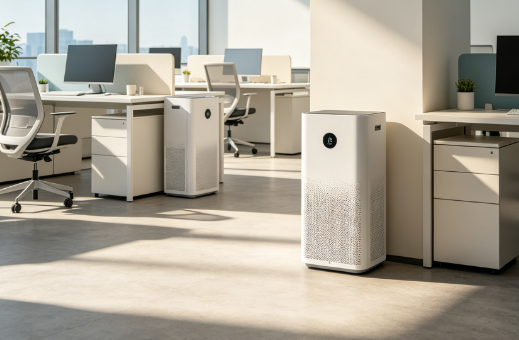
1. Understanding Office Space Types: Open-Plan vs. Private vs. Mixed-Use
Office air purifier selection begins with a clear classification of the spaces you need to serve. The three primary office space types have fundamentally different air quality requirements:
Open-Plan Offices (50-500 sqm)
Characteristics: Large, undivided floor plates with 20-200+ workstations. Air contaminant sources are distributed across the entire space (human respiration, dust from clothing/furniture, VOCs from cleaning products and office equipment). The primary challenge is achieving uniform air cleaning coverage across a large area with minimal dead zones.
• Recommended approach: Multiple high-CADR units placed at strategic intervals rather than a single oversized unit.
• Key metric: Air Changes per Hour (ACH). For open-plan offices, aim for 3-5 ACH — meaning the entire room’s air volume should be filtered 3-5 times every hour.
Private Offices & Meeting Rooms (10-50 sqm)
Characteristics: Enclosed spaces with 1-8 occupants. CO₂ buildup from respiration is a significant concern in poorly ventilated spaces. Acoustic privacy is critical — a noisy air purifier in an executive office or client meeting room is a non-starter. Aesthetics also matter more in these visible, high-touch spaces.
• Recommended approach: Quiet, compact units with sleep/meeting mode and low-noise operation below 35 dB.
• Key metric: CADR matched to room volume, not just floor area. A 4-meter ceiling height doubles the air volume compared to a standard 2.5-meter residential ceiling.
Mixed-Use & Shared Facilities (reception, breakout, cafeteria)
Characteristics: High foot traffic, intermittent occupancy, multiple odor sources (food, coffee, cleaning). These spaces need robust filtration that can handle particulate matter AND gaseous pollutants. Units may run continuously or on occupancy-based schedules.
• Recommended approach: High-CADR units with enhanced activated carbon filtration for odor control.
• Key metric: Combined CADR for particulates AND carbon filter capacity (measured in grams of VOC absorption).
2. CADR Calculation: Matching Purifier Capacity to Office Room Size
Clean Air Delivery Rate (CADR) is the most important technical specification for B2B office air purifier procurement. It measures the volume of filtered air a purifier delivers per unit of time, expressed in cubic meters per hour (m³/h) or cubic feet per minute (CFM). A purifier’s CADR rating tells you, objectively, how large a room it can effectively serve.
The industry-standard formula for matching CADR to room size is:
Room Area (m²) = CADR (m³/h) × 0.08 to 0.12
The coefficient (0.08-0.12) varies by ceiling height and target ACH. For most office applications with 2.5-3.0m ceilings, use 0.08 for basic air cleaning (2 ACH) and 0.05-0.06 for enhanced cleaning (4-5 ACH), which we recommend for open-plan offices.
|
Office Type |
Room Size |
Target ACH |
CADR Needed |
Units |
AirDow Model |
| Private Office |
15-20 m² |
4-5 |
100-150 m³/h |
1 × Desktop |
ADA609 (120 m³/h) |
| Meeting Room |
25-35 m² |
4-5 |
200-300 m³/h |
1 × Floor |
ADA622 (200 m³/h) |
| Small Open Office |
50-80 m² |
3-4 |
300-400 m³/h |
2 × Floor |
(600 m³/h) |
| Large Open Office |
100-150 m² |
3-4 |
600-900 m³/h |
3-4 × Floor |
(600 m³/h) |
| Boardroom |
30-50 m² |
5-6 |
250-400 m³/h |
1 × Floor |
ADA682 (350 m³/h) |
| Cafeteria/Breakout |
60-100 m² |
4-5 |
500-800 m³/h |
2 × Floor |
KJS999 (803 m³/h) |
Note: The above recommendations assume standard 2.5-3.0m ceiling heights. For spaces with high ceilings (atrium lobbies, converted industrial offices), recalculate using actual room volume (m³), not floor area (m²).
3. Noise Constraints: The Overlooked Dealbreaker in Office Air Purifier Selection
In the B2B office air purifier market, noise performance is often the difference between a successful deployment and a returned shipment. An air purifier that performs brilliantly on CADR but produces 55+ dB of operational noise will be rejected by office managers — and rightfully so.
The World Health Organization (WHO) recommends background noise levels below 35 dB for environments requiring concentration, and below 30 dB for spaces where speech intelligibility matters. Here is how noise constraints should guide your air purifier selection by office type:
|
Office Zone |
Max Acceptable dB |
Fan Speed Setting |
B2B Procurement Consideration |
| Executive Office |
≤ 30 dB |
Sleep/Low |
Specify units with sub-30dB sleep mode; verify with independent testing |
| Meeting Room |
≤ 35 dB |
Low-Medium |
Look for ‘meeting mode’ or timer-controlled auto-silence features |
| Open-Plan Desk Area |
≤ 45 dB |
Medium |
Acceptable noise floor is higher; prioritize CADR at medium speed |
| Reception / Lobby |
≤ 45 dB |
Medium-High |
Aesthetics as important as acoustics; consider designer-enclosure models |
| Break / Cafeteria |
≤ 50 dB |
High |
Ambient noise masks purifier; maximize CADR without noise concern |
Procurement tip: Always request the supplier’s noise test report at each fan speed setting (not just the lowest). A purifier that is quiet at ‘sleep’ mode but unusably loud at the speed needed to achieve the claimed CADR is a specification mismatch waiting to happen.
4. Multi-Unit Deployment Strategies for Large Offices
For spaces exceeding 80 m², a single centralized air purifier is almost never the optimal solution. Multi-unit deployment — strategically positioning several medium-capacity units — consistently outperforms a single large unit on air distribution uniformity, noise management, and operational redundancy.
Here are five deployment principles for multi-unit office air purifier installations:
Principle 1: Coverage Overlap, Not Isolation
Position units so their effective coverage radii have 15-20% overlap. This eliminates dead zones where stagnant, unfiltered air accumulates. For a rectangular open-plan office of 200 m², three units placed in a triangular formation nearly always outperform four units placed in corners.
Principle 2: Airflow Path Consideration
Do not place air purifiers against walls or behind furniture. A minimum 30 cm clearance on all intake sides is essential. For units with 360° air intake (cylindrical designs), position them in open floor areas. For front-intake units, orient them to pull air from high-traffic zones and direct clean air toward workstation clusters.
Principle 3: Zoned Speed Management
Not every zone in an office needs the same filtration intensity. A hot-desking bullpen may need medium-speed continuous operation, while a CEO’s office can run on auto-mode with the PM2.5 sensor triggering higher speeds only when needed. Modern IoT-enabled purifiers allow facility managers to set per-zone schedules and speeds via a centralized app — a feature worth prioritizing in B2B RFQs.
Principle 4: Redundancy for Business Continuity
With three units covering a space that requires only two at full capacity, you gain operational redundancy. If one unit fails or requires filter replacement, air quality does not crash — the remaining units pick up the slack. This is especially valuable in 24/7 facilities like call centers or server-adjacent offices where downtime is costly.
Principle 5: HVAC Integration Awareness
Standalone air purifiers should complement, not fight, the building’s HVAC system. Avoid placing purifiers directly under supply air diffusers, where filtered air is immediately diluted by incoming ventilation air. Work with the facility’s mechanical engineer to map airflow patterns before finalizing purifier locations.
5. Bulk Procurement: What B2B Buyers Should Specify in an Office Air Purifier RFQ
When issuing a Request for Quotation (RFQ) for office air purifier procurement, the following specifications should be explicitly stated to ensure comparable bids and avoid specification mismatch:
- • CADR rating (m³/h) at the fan speed required for coverage — not just the maximum CADR printed on the box.
- • Noise level (dB) at each operational fan speed, measured at 1 meter, per ISO 3744 or equivalent.
- • Filter class (H13 True HEPA minimum for commercial office use). Specify ‘H13 per EN 1822′ not ‘HEPA-type’.
- • Activated carbon filter weight in grams. A minimum of 500g is recommended for office environments with printers, cleaning chemicals, or new-furniture off-gassing.
- • PM2.5 sensor specification and display type. Auto-mode accuracy depends on sensor quality.
- • IoT connectivity standard (WiFi 2.4GHz minimum, Tuya or equivalent platform) for multi-unit management.
- • Filter replacement cost per unit per year and availability guarantee (minimum 5 years of filter supply commitment).
- • Warranty terms: 2-year minimum on electronics, with clearly defined after-sales response time for commercial clients.
- • Certification package: CE (EU), UL (USA), or KC (Korea) depending on target market, plus RoHS compliance.
- • Lead time for initial order and repeat orders. Standard 35-45 days is industry-norm for OEM production.
6. AirDow’s Office Air Purifier Solutions for B2B Buyers
At ADA Electrotech (Xiamen) Co., Ltd., we manufacture a complete range of office-grade air purifiers designed for B2B commercial deployment. Our key office product lines include:
- • ADA609 — 120 m³/h desktop unit ideal for private offices and small meeting rooms. 50dB max, sub-30dB sleep mode.
- • ADA622 — 200 m³/h compact floor unit with PM2.5 sensor, auto-mode, and UV sterilization. Ideal for 25-35 m² meeting rooms.
- — 600 m³/h high-CADR floor unit with remote control and filter change indicator. Designed for open-plan offices up to 80 m² per unit.
- • ADA682 — 350 m³/h premium floor unit with WiFi IoT connectivity, Tuya app control, and multi-stage filtration (HEPA + carbon + UV + ionizer). Boardroom grade.
- • KJS999 — 803 m³/h commercial-grade unit for large open offices, conference halls, and cafeteria spaces up to 100 m² per single unit.
All units are available for OEM/ODM customization with your branding, color, voltage, and plug configuration. We hold UL, CE, CB, FCC, RoHS, KC, and ISO 9001 certifications — enabling seamless import into North America, Europe, Asia, and the Middle East.
Need help planning your office air purifier deployment? Contact Locke at locke@airdow.com — we’ll help you build a room-by-room specification and quotation within 48 hours.
Frequently Asked Questions About Office Air Purifier Selection
Q: How many air purifiers does a 200 m² open-plan office need?
For a 200 m² open-plan office with standard 2.8m ceilings (560 m³ air volume), targeting 4 ACH, you need a total CADR of approximately 560 m³/h. This can be achieved with 3 × units (600 m³/h each at medium speed, providing ~1,200 m³/h combined, giving you headroom and redundancy) or 1 × KJS999 if the space is roughly rectangular and unobstructed.
Q: What is the difference between a home air purifier and an office-grade unit?
While the core filtration technology (HEPA + carbon) is similar, office-grade air purifiers differ in: (1) higher CADR ratings for larger spaces, (2) reinforced duty cycles designed for 12-24 hour continuous operation, (3) commercial-grade fan motors with 20,000+ hour lifespans, (4) IoT management capabilities for multi-unit fleet control, and (5) filter service indicators that can be monitored remotely by facility management teams.
Q: Should air purifiers run 24/7 in an office environment?
For offices with continuous occupancy (call centers, 24/7 operations), yes. For standard 9-to-5 offices, we recommend: run at medium-high speed 30 minutes before occupancy begins (pre-purge), switch to auto-mode during occupied hours, and run at low speed or sleep mode during unoccupied hours to maintain baseline air quality. IoT-enabled units can automate this entire schedule.
Q: How do I calculate the total cost of ownership for office air purifiers?
TCO = Unit purchase price + (Annual filter replacement cost × warranty years) + (Power consumption in kW × annual operating hours × local electricity rate × years) + estimated maintenance labor. For a typical office deployment of 10 units over 3 years, the filter replacement cost often exceeds the initial unit purchase price — a factor many first-time B2B buyers overlook. Always request a 3-year TCO breakdown from your supplier.
Conclusion: Office Air Purifier Selection Is a Strategic Procurement Decision
Selecting air purifiers for an office environment is fundamentally different from buying a consumer-grade unit for a bedroom or living room. It requires systematic room-by-room assessment, CADR-based capacity calculations, noise constraint management, multi-unit deployment planning, and total cost of ownership analysis. For B2B buyers, getting this right means satisfied corporate clients, repeat orders, and a reputation for delivering real indoor air quality improvements — not just moving boxes.
The frameworks and tables provided in this guide give you a repeatable, defensible methodology for specifying office air purifier deployments at any scale — from a single private office to a multi-floor corporate headquarters.
Disclaimer: CADR recommendations in this article are based on standard office configurations. Actual requirements may vary based on ceiling height, partition layout, occupancy density, and local ventilation standards. Always conduct a site-specific assessment before finalizing procurement specifications.
Post time: Jun-10-2026


