
The best air purifier is the one that runs precisely when it is needed — and an integrated PM2.5 sensor makes that possible.
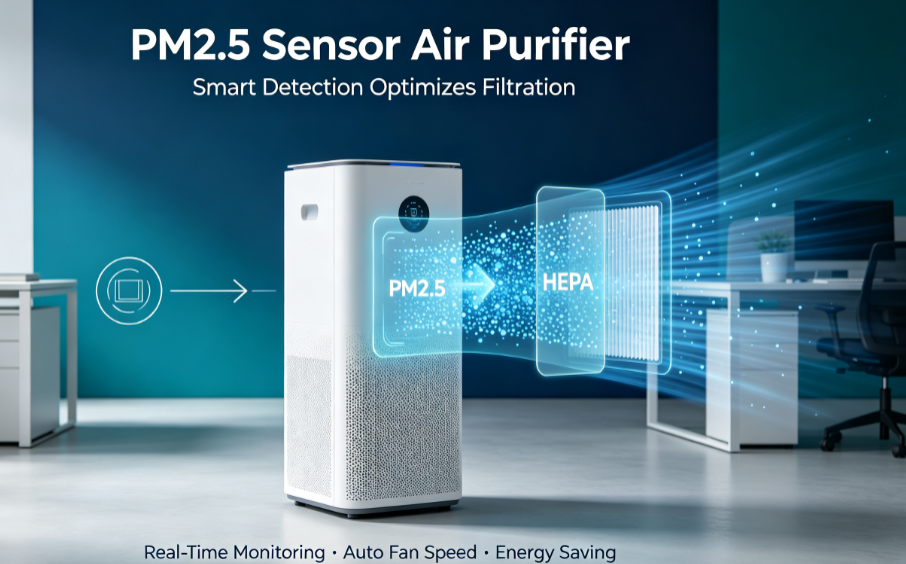
A PM2.5 sensor air purifier uses a built-in particulate matter detector to continuously monitor fine particle concentration in ambient air. When pollution levels rise, the sensor triggers automatic adjustments — increasing fan speed, activating specific filtration stages, and displaying real-time air quality feedback. When the air is clean, the unit automatically slows down or enters standby, saving energy and extending filter life.
For B2B buyers, PM2.5 sensor integration has moved from a premium feature to an expected baseline in consumer air purifiers across all market segments. This article covers how PM2.5 sensors work, the key specifications for OEM sourcing, and how smart detection creates genuine value for end users.
How PM2.5 Sensors Work in Air Purifiers
Laser Scattering Technology
Most modern air purifiers use laser-based particle sensors. A small fan draws air into a detection chamber where a laser diode illuminates any particles present. When particles pass through the laser beam, they scatter light. A photodetector measures the scattered light intensity — more particles = more light = higher PM reading. The sensor’s microcontroller analyzes patterns to distinguish PM1.0, PM2.5, and PM10 sizes, providing near-instantaneous readings updated every 1-5 seconds.
Key Sensor Components
• Laser diode (650nm red or 905nm IR) — provides illumination
• PIN photodiode — measures scattered light; sensitivity determines minimum detectable particle size
• Signal MCU — converts raw signals to particle counts; calibration corrects for humidity and aging
• Air intake (micro-fan) — draws consistent sample; flow stability affects accuracy
• Factory calibration — against reference instrument; well-calibrated sensors achieve <±10 µg/m³ error
Smart Detection Features That Create Real User Value
Auto Mode: Automatic Fan Speed Adjustment
When the PM2.5 sensor detects rising pollution, the purifier automatically increases air flow. As air clears, it reduces speed. Key parameters for B2B buyers: response speed (target <10 sec), threshold levels (4-6 speed steps), and hysteresis (prevents oscillation around a threshold).
Real-Time Air Quality Display
• Color-coded LED: Green (<35 µg/m³) → Yellow (35-75) → Red (>75) following EPA/AQI color standards
• Numeric PM2.5 display in µg/m³; some models also show PM10, temperature, humidity
• WiFi/BLE app sync via Tuya Smart platform for historical data and remote control
Filter Lifetime Tracking
Advanced sensors track filter saturation by monitoring how quickly the reading responds to fan speed changes. A clean filter shows rapid PM2.5 drop when fan speed increases; a saturated filter shows little change. This enables filter-life estimation without separate timer components.
PM2.5 Sensor Specifications for OEM Product Design
When sourcing PM2.5 sensors for your product line:
|
Specification |
Typical Value |
Why It Matters |
| Range | 0-500/1000 µg/m³ | Broader range works in polluted markets (India, China) |
| Resolution | 1 µg/m³ | Industry standard |
| Accuracy | <±10 or <±15% | At 0-100 µg/m³; degrades at higher levels |
| Response | <10 sec | Time to 90% of final reading |
| Sizes | PM1.0/PM2.5/PM10 | Multi-size enables rich display and auto logic |
| Lifespan | 20,000-30,000 hr | ~2-3 years continuous laser operation |
| Interface | UART/I2C/PWM | UART most common for MCU integration |
| Temp Range | -10 to +60°C | Reliable across climate zones |
| OEM Cost | $3-$8/unit | Volume pricing at 10K+ MOQ |
PMS5003-series sensors (Plantower) are the de facto standard for consumer purifiers, offering the best price-performance. Honeywell and Sensirion offer higher-accuracy options for premium lines.
Sensor Placement: Why Location Matters More Than the Sensor
The most accurate sensor gives misleading readings if wrongly placed. Two critical considerations:
• Intake vs. exhaust: Sensor in intake path reads room air (correct). Sensor after HEPA reads cleaned air (falsely low). Dual-sensor designs measure both for efficiency validation.
• Airflow bypass: Sensor needs a consistent air sample. Avoid dead zones behind baffles. Ensure the sensor’s micro-fan draws fresh sample independently of main airflow.
How Smart Detection Creates Tangible User Benefits
✓ Energy savings: Auto mode reduces average fan speed 40-60%, cutting electricity costs roughly 50%
✓ Filter life extension: Fan runs only when needed, extending HEPA/carbon intervals
✓ Noise reduction: High speed only when needed. Night operation at ~20-30 dB is nearly silent
✓ Peace of mind: Real-time AQI display gives visible proof the purifier is working — top driver of satisfaction
✓ Remote monitoring: WiFi-connected users check home air from anywhere; drives significant purchase intent
Limitations and Design Considerations
✗ No VOC/gas detection: Standard PM2.5 sensors do not detect formaldehyde, VOCs, or CO2. Separate gas sensors needed.
✗ Humidity interference: >85% RH causes particle swelling and false high readings. Some sensors include humidity compensation.
✗ Calibration drift: Over 2-3 years, laser power degrades and optics accumulate contamination. Replacement is the norm.
✗ Steam false triggers: Humidifiers or cooking steam can cause false PM readings. Some units apply 30-60s lockout after humidity spikes.
Conclusion: Smart Detection as a Competitive Requirement
PM2.5 sensor integration has moved from differentiator to baseline expectation. In 2026, the question is no longer whether to include a sensor — it is which sensor and how intelligently the system uses the data.
1. Laser-based PM2.5 sensors (PMS5003-class) offer reliable performance at $3-8 OEM cost, viable even for entry-level products
2. Auto mode with real-time AQI display is the minimum viable smart feature set. WiFi/IoT is the next tier
3. Sensor placement and airflow design affect accuracy more than the sensor module itself
4. Filter replacement tracking via sensor data extends filter life 20-30% and improves total cost of ownership
5. Smart PM2.5 purifiers command 25-40% higher retail margins than basic manual-speed units
Interested in adding smart PM2.5 sensor functionality to your air purifier line? Contact us at ada5@airdow.com for OEM sensor module specifications, integration support, and product design consultation.
Post time: Jul-28-2026


