
A car cabin is one of the smallest, most enclosed spaces people spend hours in every week. A USB ionizer is one of the few air treatment products that fits there.
The average vehicle cabin holds roughly 3-4 m³ of air — less than a small bathroom — and is loaded with off-gassing plastics, leather treatments, dust, and exhaust ingress. Full-size HEPA purifiers are impractical in that space: they need significant power, occupy cup holders or seats, and produce noise in a confined area. USB car ionizers fill that gap by offering a small, low-power, plug-in air treatment option that requires no installation and no maintenance.
This guide covers how USB ionizers work inside a vehicle, the specifications that actually matter, placement strategy, and the honest limits of what compact ionizers can and cannot achieve for vehicle air quality.
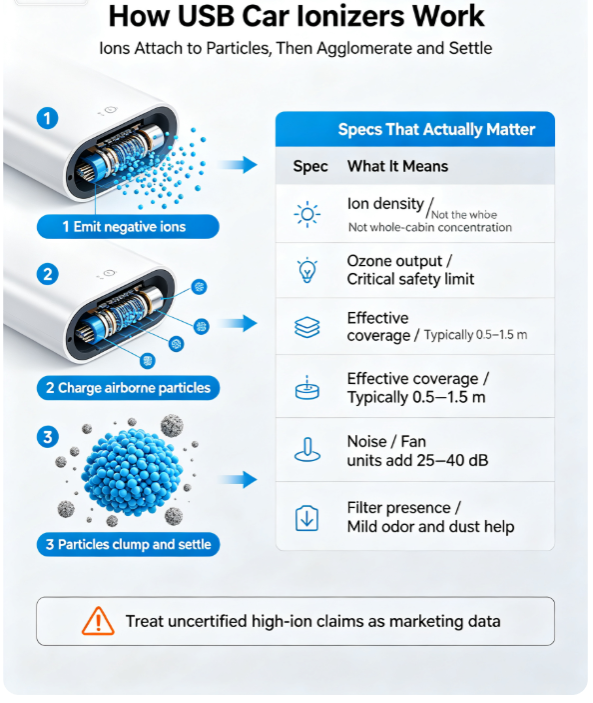
How USB Car Ionizers Work
• Ion generation — A high-voltage needle or carbon-fiber brush emits negative ions (typically 1-10 million ions/cm³ at close range). These ions attach to airborne particles — dust, smoke, pollen, exhaust soot — giving them an electric charge.
• Particle agglomeration — Charged particles attract each other and clump into larger clusters heavy enough to settle out of the air or be captured on cabin surfaces.
• Odor neutralization — Ions react with some odorous compounds and airborne VOCs through oxidation, reducing perceived odors. This is a chemical effect, not a masking fragrance.
• No fan, often no filter — Many units are passive: ions are released into the cabin and the air movement comes from the vehicle’s own ventilation system. Some include a small fan (and occasionally a thin filter) for active airflow.
Power Options and Form Factors
|
Model Type |
Power Source |
Characteristics |
| USB-A plug-in | 5V USB port (1-2W) | Smallest and cheapest; works in any car with a USB port; lowest ion output |
| 12V socket (cigarette lighter) | 12V DC (2-5W) | Strongest output of the compact class; occupies the dashboard socket |
| USB-C / dual port | 5V USB-C or PD | Modern connector; can share a charging port with a splitter |
| Vent-clip mini | 5V USB (0.5-1.5W) | Clips on air vents; ions enter the HVAC airflow directly; very small footprint |
| Cup-holder unit | 12V or USB (1-3W) | Larger ionizer array plus small fan; often includes a filter cartridge |
| Rechargeable / battery | Built-in Li-ion (1-3W) | Usable without a cable; needs periodic charging; battery adds bulk and cost |
Specifications That Actually Matter
Ion output is the headline spec on every USB ionizer box — and the least reliable one. Here is how to read the numbers:
✓ Ion density (ions/cm³) — Usually quoted at 1-10cm from the emitter, where values of several million are common. This is not the cabin concentration. Useful comparisons require the measurement distance to be stated; if it is not, treat the number as marketing.
✓ Effective coverage — In practice, a single compact ionizer meaningfully treats the air within about 0.5-1.5m of itself. For an entire cabin, either place it near the HVAC intake or accept uneven treatment.
✓ Ozone output — The critical safety spec. Any ionizer that produces a corona discharge can generate ozone as a by-product. Look for a stated ozone output below 0.05 ppm (and preferably a certification such as CARB or CE + EN 60335-2-65). Avoid unregulated units that claim high power without an ozone figure.
✓ Noise — Passive units are silent. Fan-equipped units typically run 25-40 dB — noticeable but not intrusive in a moving vehicle.
✓ Power draw — 0.5-5W, negligible for a car’s electrical system. Battery-powered units do not draw from the vehicle at all.
✓ Filter presence — If the unit includes a filter, it is usually a thin carbon or electrostatic layer. It contributes mildly to odor and dust reduction and needs periodic replacement.
Placement Strategy Inside the Cabin
1. Near the HVAC intake — The single most effective placement. If ions are released where the cabin air is drawn in for recirculation, the ventilation system distributes them through the whole cabin.
2. Dash or center console — Good for reach and visibility; effectiveness limited to the front seats unless the HVAC fan is running.
3. Vent clip — Excellent for mixing ions into the airflow, but the ionizer is then subject to condensation from the AC, which reduces emitter life.
4. Cup holder or seat-back — Convenient and stable; rear placement serves passengers but leaves the driver’s breathing zone underserved.
5. Avoid direct face airflow — Do not point an active ionizer at a passenger’s face. People vary in sensitivity to charged air, and a direct stream is unnecessary.
6. Run the HVAC fan on low — Most compact ionizers perform noticeably better with the cabin fan on low, because airflow carries ions beyond the immediate vicinity.
Honest Expectations: What USB Ionizers Can and Cannot Do
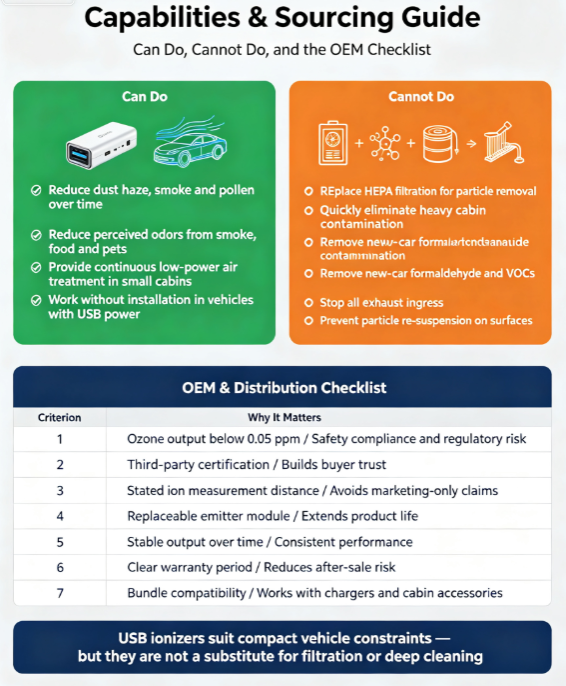
✓ Can do — Reduce airborne dust, smoke haze, and pollen over time; reduce perceived odors from smoke, food, and pets; provide a small continuous air treatment effect with no installation.
✓ Can do partially — Help with exhaust and traffic odor ingress, mainly through odor neutralization rather than removal.
✓ Cannot do — Replace a HEPA filter for particle capture. Ionizers move particles to surfaces rather than trapping them; some of those particles can be re-suspended.
✓ Cannot do — Eliminate formaldehyde and VOCs from new car interiors. That requires carbon adsorption or ventilation, and new-vehicle off-gassing lasts months.
✓ Cannot do — Clean a heavily contaminated cabin quickly. Ionizers work gradually in a small space; a needed deep clean still requires vacuuming and ventilation.
Care and Longevity
• Clean the emitter tip every 2-4 weeks — Dust buildup on the ion-emitting needle or brush reduces output. A dry cotton swab is usually sufficient.
• Do not wash — Keep the housing dry. Internal moisture is the most common cause of failure in car ionizers.
• Expect 1-3 years of service — Emitter tips degrade with use; replaceable emitter modules extend product life considerably.
• Check filter cartridges — For filter-equipped models, follow the manufacturer’s replacement interval (usually 2-3 months of daily driving).
Market Context for OEM and Distribution Buyers
• Price bands — Generic USB ionizers sell retail at $3-10; branded units with ozone certification and better materials sell at $12-30. The category is price-sensitive but not purely commodity: certification is a real differentiator.
• High-volume channels — Automotive aftermarket, e-commerce marketplaces, gift and accessory bundles, and fleet/rideshare supply.
• Regional requirements — CARB (California) regulates ozone output in the US and many markets follow its precedent. Units above 0.05 ppm cannot be legally sold as air purifiers in several jurisdictions.
• Bundling — USB car ionizers pair naturally with car mounts, chargers, and cabin accessories, making them attractive add-on items with strong attach rates.
• Quality signal — In a category with low consumer trust, verifiable ozone testing, stable ion output over time, and a printed warranty period separate credible suppliers from anonymous ones.
Conclusion: A Compact Solution with Clear Limits
1. USB car ionizers suit the vehicle cabin’s constraints — tiny space, limited power, no installation — better than any full-size purifier can
2. Ion output claims are only comparable when the measurement distance is stated; cabin-level effectiveness is realistic within 0.5-1.5m of the unit
3. Ozone output is the safety spec that matters most — require a stated figure below 0.05 ppm and third-party certification
4. Placement near the HVAC intake and running the fan on low multiplies effectiveness far more than paying for a higher ion count
5. Understand the limits: ionizers reduce dust haze and odors gradually but do not replace HEPA filtration or remove new-car formaldehyde
Sourcing USB car ionizers or building a vehicle air treatment line? Contact us at ada5@airdow.com for OEM specifications, ozone test reports, and product customization options.
Post time: Sep-29-2026


