
One filter handles particles. Six filters handle everything.
Indoor air is a complex mixture of particulate matter, gases, odors, and biological contaminants. A basic single-stage air purifier with only a HEPA filter can capture particles — but it does nothing about formaldehyde, cooking odors, or bacteria. A multi-stage air purification system addresses each pollutant class with a dedicated stage, delivering comprehensive air cleaning that no single technology can match.
For B2B buyers, understanding what each stage actually does — and which combinations deliver genuine performance value versus marketing theater — is essential for building a competitive product line. This article breaks down each stage of a 6-stage purification system, what it removes, and why multi-stage design wins in real-world performance.
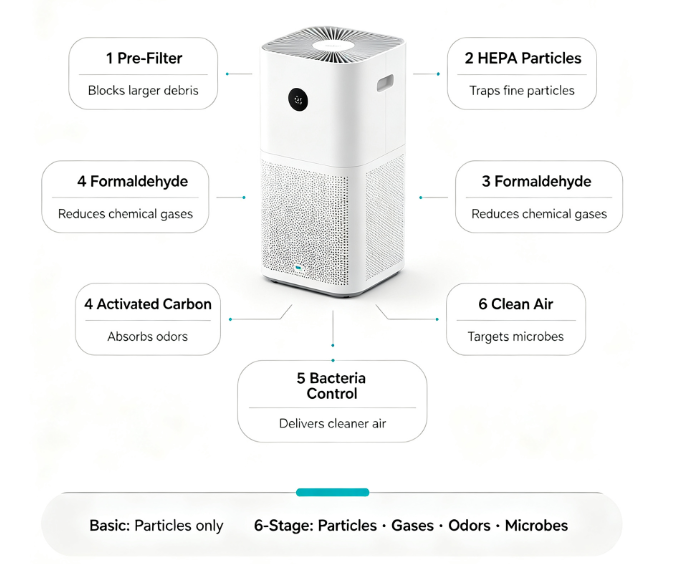
The 6 Stages of a Multi-Stage Air Purifier
A typical 6-stage air purifier combines the following technologies in sequence. Each stage handles a specific pollutant class:
Stage 1: Pre-Filter — The First Line of Defense
A coarse mesh or non-woven fabric filter that captures large particles: dust, hair, pet dander, and lint (>10 µm). The pre-filter protects downstream stages from clogging and extends HEPA filter life by 2-3x. Most pre-filters are washable and reusable, making them a low-cost, high-impact first stage.
Stage 2: HEPA Filter — The Particle Workhorse
A True HEPA (H13/H14 grade) filter captures 99.97% of particles at 0.3 µm — the most penetrating particle size. This stage handles PM2.5, PM10, pollen, mold spores, dust mites, and bacteria carried on particles. HEPA is the only stage that physically removes fine particulate matter from the air stream, and it is the performance backbone of any serious purifier.
Stage 3: Activated Carbon — The Gas Adsorber
Activated carbon (typically coconut-shell based) adsorbs gaseous pollutants: VOCs, formaldehyde, benzene, tobacco smoke gases, and odors. The carbon’s highly porous structure (1 gram = ~1,000 m² surface area) traps gas molecules physically. Important: carbon saturates over time and must be replaced — its lifespan depends heavily on the pollution load it faces.
Stage 4: UV-C Light — The Germicidal Stage
A UV-C lamp (254nm wavelength) inactivates bacteria, viruses, and mold spores by damaging their DNA/RNA, preventing reproduction. UV-C works best in combination with HEPA: HEPA captures the pathogens, and UV-C inactivates them. The lamp must be fully shielded to prevent direct UV exposure to users. Typical lifespan: 8,000-12,000 hours.
Stage 5: Negative Ion Generator — The Particle Charger
A negative ion generator charges remaining submicron particles (0.01-0.1 µm) that pass through HEPA. Charged particles agglomerate into larger clusters that are then more easily captured on the next air pass through the HEPA filter. This creates a positive feedback loop that improves overall system efficiency over time. Ozone output must be certified <50 ppb for safety.
Stage 6: Cold Catalyst / Photocatalyst — The Chemical Destructor
The final stage uses catalytic technology to chemically destroy pollutants that the carbon stage cannot fully handle. Cold catalyst (room-temperature catalytic oxidation) breaks down formaldehyde and odors without UV; photocatalyst (TiO₂ + UV) decomposes VOCs, bacteria, and mold at the molecular level. This stage converts pollutants to harmless CO₂ and H₂O rather than just trapping them.
Why Multi-Stage Systems Deliver Superior Results
The performance gap between single-stage and multi-stage purifiers is not incremental — it is categorical. Here is what the comparison looks like:
• Particle coverage: Single-stage HEPA handles particles only. Multi-stage adds ion charging for submicron particles HEPA misses.
• Gas coverage: Single-stage HEPA removes zero gases. Carbon + catalyst stages address formaldehyde, VOCs, and odors.
• Biological coverage: Single-stage HEPA captures bacteria but does not kill them. UV-C inactivates them, preventing regrowth in the filter.
• Filter lifespan: The pre-filter protects HEPA, extending replacement intervals from 6 months to 12-18 months in typical use.
• Real-world efficiency: Multi-stage systems maintain higher CADR over time because each stage protects the next from premature loading.
Stage-by-Stage Performance Comparison
What Each Stage Removes
|
Stage |
Removes |
Does Not Remove |
Replacement Cycle |
| 1. Pre-Filter | Large dust, hair, dander | Fine particles, gases | Washable (reuse 6-12 mo) |
| 2. HEPA H13 | PM2.5, pollen, bacteria | Gases, odors, VOCs | 6-18 months |
| 3. Carbon | VOCs, formaldehyde, odors | Particles | 3-6 months (heavy use) |
| 4. UV-C | Bacteria, viruses, mold | Particles, gases | Lamp 8,000-12,000 hr |
| 5. Ionizer | Submicron particles (charging) | Gases, odors | No consumable (clean emitter) |
| 6. Catalyst | Formaldehyde, odors, VOCs | Particles | 3-5 years |
Common Multi-Stage Configurations in the Market
Not all multi-stage purifiers are created equal. Here are the common configurations B2B buyers will encounter:
• 3-Stage (Pre-filter + HEPA + Carbon) — The entry-level standard. Covers particles and basic gases. Adequate for general household use in moderate pollution areas.
• 4-Stage (adds UV-C or Ionizer) — Adds biological protection or particle charging. Common mid-range configuration; the added stage is often the key marketing differentiator.
• 5-Stage (Pre-filter + HEPA + Carbon + UV-C + Ionizer) — The typical “premium” configuration. Full particle, gas, and biological coverage.
• 6-Stage (adds Cold Catalyst / Photocatalyst) — The flagship configuration. Adds chemical destruction of formaldehyde and persistent odors — the strongest selling point for new-home and renovation markets.
How to Verify Multi-Stage Performance Claims
The term “6-stage” is frequently used as a marketing label without meaningful performance validation. B2B buyers should verify:
✓ CADR per stage — Request CADR test reports (GB/T 18801 or AHAM AC-1) showing the contribution of each stage. A purifier is only as fast as its weakest stage.
✓ Formaldehyde CADR — For units claiming carbon/catalyst VOC removal, formaldehyde CADR (measured in m³/h) is the key metric. A 6-stage unit with no formaldehyde CADR data is not delivering gas removal.
✓ UV-C dose — Germicidal effectiveness depends on UV dose (intensity × exposure time). Ask for the UV dose and lab test results against specific pathogens (e.g., H1N1, E. coli).
✓ Ozone certification — If the unit includes an ionizer, request ozone output certification (<50 ppb) from an accredited lab.
✓ Filter replacement cost — Multi-stage systems have multiple consumables. Calculate the total annual filter cost — this is often 2-3x higher than single-stage units and affects end-user total cost of ownership.
Cost Analysis: Is 6-Stage Worth the Premium?
The honest answer: it depends on the target market and use case.
• For new homes and renovations — Yes. Formaldehyde off-gassing is the #1 indoor air complaint, and only carbon + catalyst stages address it. A 6-stage purifier is the strongest solution.
• For allergy households — A 3-4 stage unit (HEPA + pre-filter, optionally UV) delivers 90% of the value at 60% of the cost. The catalyst stage adds little for allergy sufferers.
• For smoking/pet households — The carbon + catalyst combination is valuable for persistent odors. A 5-6 stage unit is justified.
• For B2B margins — The BOM cost of adding UV-C, ionizer, and catalyst stages is roughly $8-20 per unit, supporting $30-80 higher retail pricing. Margin expansion is significant when the feature set is credible.
Red Flags: When “6-Stage” Is Marketing Theater
✗ Counting a fan, a power switch, or the housing as a “stage” — Some brands inflate stage counts with non-filtration elements.
✗ Carbon-coated HEPA counted as two stages — A combined HEPA+carbon composite is one functional stage, not two.
✗ No performance data per stage — If the brand cannot show CADR or removal data per stage, the stage count is likely cosmetic.
✗ Unverifiable claims — “99.99% removal” without specifying pollutant, test standard, or chamber conditions is not a meaningful claim.
Conclusion: Designing a Credible Multi-Stage Product
Multi-stage filtration is the right engineering answer to the complexity of indoor air pollution — but only when each stage genuinely performs. The winning formula for B2B buyers:
1. Match stage count to target market: 3-4 stages for value segments, 5-6 stages for premium and problem-specific markets (new homes, smoke, pets)
2. Demand per-stage performance data (CADR, formaldehyde CADR, UV dose, ozone certification) from suppliers before committing
3. Price the consumables honestly — filter replacement cost is a major end-user decision factor and a recurring revenue stream for you
4. Differentiate with the catalyst stage — chemical destruction is the most credible upgrade story versus basic particle filtration
5. Verify claims with third-party lab reports — credibility is the #1 differentiator in a market full of stage-count inflation
Interested in building a credible multi-stage air purifier product line? Contact us at ada5@airdow.com for stage-by-stage performance data, OEM filter options, and product configuration consultation.
Post time: Aug-12-2026


